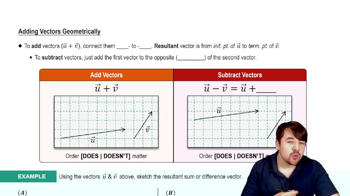
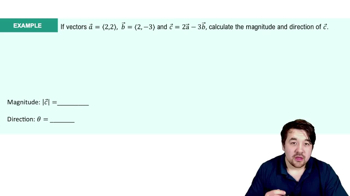
Use the figure to find each vector: u - v. Use vector notation as in Example 4.
Verified step by step guidance
1
Identify the components of vectors \( \mathbf{u} \) and \( \mathbf{v} \) from the figure. Typically, each vector can be expressed in component form as \( \mathbf{u} = \langle u_x, u_y \rangle \) and \( \mathbf{v} = \langle v_x, v_y \rangle \), where \( u_x \) and \( u_y \) are the horizontal and vertical components of \( \mathbf{u} \), and similarly for \( \mathbf{v} \).
Recall that vector subtraction \( \mathbf{u} - \mathbf{v} \) is performed by subtracting the corresponding components of \( \mathbf{v} \) from \( \mathbf{u} \). This means \( \mathbf{u} - \mathbf{v} = \langle u_x - v_x, u_y - v_y \rangle \).
Calculate the horizontal component of \( \mathbf{u} - \mathbf{v} \) by subtracting the horizontal component of \( \mathbf{v} \) from that of \( \mathbf{u} \): \( u_x - v_x \).
Calculate the vertical component of \( \mathbf{u} - \mathbf{v} \) by subtracting the vertical component of \( \mathbf{v} \) from that of \( \mathbf{u} \): \( u_y - v_y \).
Write the resulting vector in component form as \( \mathbf{u} - \mathbf{v} = \langle u_x - v_x, u_y - v_y \rangle \), which is the vector notation requested.
Verified video answer for a similar problem:
This video solution was recommended by our tutors as helpful for the problem above
Play a video:
0 Comments
Key Concepts
Here are the essential concepts you must grasp in order to answer the question correctly.
Vector Representation and Notation
Vectors are quantities with both magnitude and direction, often represented as arrows or ordered pairs. Vector notation typically uses angle brackets, such as u = <x, y>, to denote components along coordinate axes. Understanding this notation is essential for performing vector operations accurately.
Vector subtraction involves finding the difference between two vectors by subtracting their corresponding components. If u = <u₁, u₂> and v = <v₁, v₂>, then u - v = <u₁ - v₁, u₂ - v₂>. This operation results in a new vector representing the displacement from v to u.
Vectors can be visualized graphically as arrows in the coordinate plane, where subtraction corresponds to placing the tail of one vector at the head of another and drawing the resultant vector. This helps in understanding the direction and magnitude of the resulting vector from u - v.


 Verified step by step guidance
 06:01
06:01