Ch. 6 - Inverse Circular Functions and Trigonometric Equations
Lial - Trigonometry 12th Edition
Lial12th EditionTrigonometryISBN: 9780136552161Not the one you use?Change textbook
Chapter 7, Problem 27

Solve each equation for exact solutions.
4/3 cos⁻¹ x/4 = π

Verified step by step guidance
1
Start by isolating the inverse cosine expression. Multiply both sides of the equation by \( \frac{3}{4} \) to get \( \cos^{-1}\left( \frac{x}{4} \right) = \frac{3}{4} \pi \).
Recall that \( \cos^{-1}(y) = \theta \) means \( \cos(\theta) = y \). So rewrite the equation as \( \cos\left( \frac{3}{4} \pi \right) = \frac{x}{4} \).
Evaluate \( \cos\left( \frac{3}{4} \pi \right) \) using the unit circle or known cosine values for special angles. Remember that \( \frac{3}{4} \pi = 135^\circ \) and cosine is negative in the second quadrant.
Set \( \frac{x}{4} \) equal to the value found in step 3, then solve for \( x \) by multiplying both sides by 4.
Consider the domain of \( \cos^{-1} \), which is \( [-1,1] \), to verify that the solution for \( x \) is valid. If necessary, check for any additional solutions within the domain.

Verified video answer for a similar problem:

This video solution was recommended by our tutors as helpful for the problem above.
Was this helpful?

Key Concepts

Here are the essential concepts you must grasp in order to answer the question correctly.

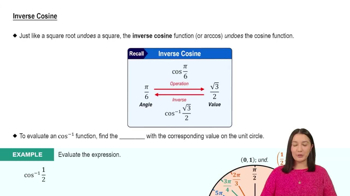
Inverse Cosine Function (cos⁻¹ or arccos)

The inverse cosine function returns the angle whose cosine is a given number. Its output range is from 0 to π radians. Understanding this function is essential to isolate the variable inside the cosine and solve for exact angle values.
Recommended video:
4:49
Inverse Cosine

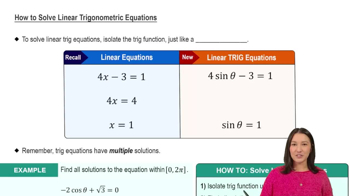
Solving Trigonometric Equations

Solving trigonometric equations involves isolating the trigonometric function and then applying inverse functions to find the angle. It also requires considering the domain and range of the inverse function to determine all possible solutions.
Recommended video:
4:34
How to Solve Linear Trigonometric Equations

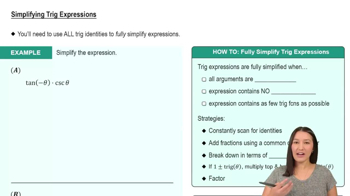
Manipulating Algebraic Expressions

Algebraic manipulation is necessary to isolate the variable inside the inverse cosine function. This includes multiplying or dividing both sides of the equation and simplifying fractions to express the variable clearly for substitution or evaluation.
Recommended video:
6:36
Simplifying Trig Expressions