Rearrange the equation to solve for \( \cos^2 \theta \): \( \cos^2 \theta = 1 - \frac{36}{49} \).
Simplify the expression to find \( \cos^2 \theta \), then take the square root to find \( \cos \theta \). Remember, since \( \theta \) is an acute angle, \( \cos \theta \) will be positive.
Verified video answer for a similar problem:
This video solution was recommended by our tutors as helpful for the problem above.
Video duration:
4m
Play a video:
0 Comments
Was this helpful?
Key Concepts
Here are the essential concepts you must grasp in order to answer the question correctly.
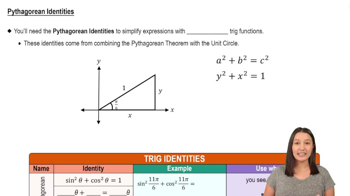
Pythagorean Identity
The Pythagorean identity states that for any angle θ, the relationship sin²θ + cos²θ = 1 holds true. This fundamental identity connects the sine and cosine functions, allowing us to derive one from the other. It is particularly useful in trigonometry for solving problems involving right triangles and circular functions.
The sine function, denoted as sin θ, represents the ratio of the length of the opposite side to the hypotenuse in a right triangle. In this context, sin θ = 6/7 indicates that for an acute angle θ, the opposite side is 6 units long while the hypotenuse is 7 units long. Understanding this ratio is crucial for applying the Pythagorean identity effectively.
The cosine function, denoted as cos θ, represents the ratio of the length of the adjacent side to the hypotenuse in a right triangle. By using the Pythagorean identity, we can find cos θ when sin θ is known. In this case, once we calculate sin²θ, we can rearrange the identity to solve for cos²θ, leading to the determination of cos θ.


 Verified step by step guidance
 6:25
6:25