Recognize that the problem asks for the cube root of 0.001, which means finding a number \( x \) such that \( x^3 = 0.001 \).
Express 0.001 as a power of 10: \( 0.001 = 10^{-3} \). This helps simplify the root calculation using exponent rules.
Use the property of roots and exponents: \( \sqrt[3]{10^{-3}} = 10^{\frac{-3}{3}} \). This means you divide the exponent by the root's degree.
Simplify the exponent: \( 10^{\frac{-3}{3}} = 10^{-1} \).
Rewrite \( 10^{-1} \) as a decimal: \( 10^{-1} = 0.1 \), which is the cube root of 0.001.
Verified video answer for a similar problem:
This video solution was recommended by our tutors as helpful for the problem above
Video duration:
1m
Play a video:
0 Comments
Key Concepts
Here are the essential concepts you must grasp in order to answer the question correctly.
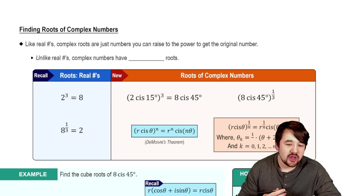
Cube Roots
The cube root of a number is a value that, when multiplied by itself three times, gives the original number. For example, the cube root of 8 is 2 because 2 × 2 × 2 = 8. It is denoted as ∛x.
Understanding decimals and their relation to powers of ten helps simplify root calculations. For instance, 0.001 can be written as 10⁻³, making it easier to apply root operations using exponent rules.
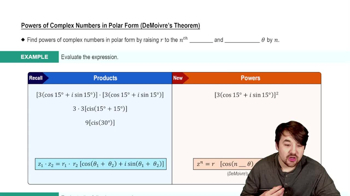
Powers Of Complex Numbers In Polar Form (DeMoivre's Theorem)
Properties of Exponents in Root Extraction
Roots can be expressed as fractional exponents, such as ∛x = x^(1/3). Applying this property allows converting roots into exponent form, facilitating calculations especially with powers of ten or other numbers.

 1:34 minutes
 Verified step by step guidance
 07:37
07:37