Ch. R - Algebra Review
Lial - Trigonometry 12th Edition
Lial12th EditionTrigonometryISBN: 9780136552161Not the one you use?Change textbook
Chapter 1, Problem 49

Find each root. See Example 3. ∛0.001

Verified step by step guidance
1
Recognize that the problem asks for the cube root of 0.001, which means finding a number \( x \) such that \( x^3 = 0.001 \).
Express 0.001 as a power of 10: \( 0.001 = 10^{-3} \). This helps simplify the root calculation using exponent rules.
Use the property of roots and exponents: \( \sqrt[3]{10^{-3}} = 10^{\frac{-3}{3}} \). This means you divide the exponent by the root's degree.
Simplify the exponent: \( 10^{\frac{-3}{3}} = 10^{-1} \).
Rewrite \( 10^{-1} \) as a decimal: \( 10^{-1} = 0.1 \), which is the cube root of 0.001.

Verified video answer for a similar problem:

This video solution was recommended by our tutors as helpful for the problem above.
Video duration:
1m
Was this helpful?

Key Concepts

Here are the essential concepts you must grasp in order to answer the question correctly.

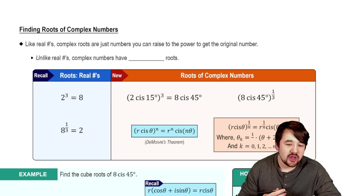
Cube Roots

The cube root of a number is a value that, when multiplied by itself three times, gives the original number. For example, the cube root of 8 is 2 because 2 × 2 × 2 = 8. It is denoted as ∛x.
Recommended video:
07:37
Complex Roots

Decimal Representation and Powers of Ten

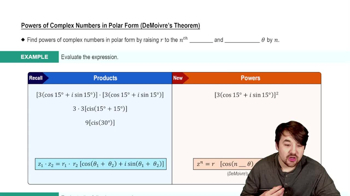
Understanding decimals and their relation to powers of ten helps simplify root calculations. For instance, 0.001 can be written as 10⁻³, making it easier to apply root operations using exponent rules.
Recommended video:
03:41
Powers Of Complex Numbers In Polar Form (DeMoivre's Theorem)

Properties of Exponents in Root Extraction

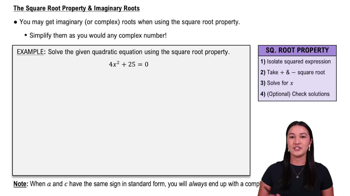
Roots can be expressed as fractional exponents, such as ∛x = x^(1/3). Applying this property allows converting roots into exponent form, facilitating calculations especially with powers of ten or other numbers.
Recommended video:
2:20
Imaginary Roots with the Square Root Property