Ch. 5 - Complex Numbers, Polar Coordinates and Parametric Equations
Blitzer - Trigonometry 3rd Edition
Blitzer3rd EditionTrigonometryISBN: 9780137316601Not the one you use?Change textbook
Chapter 5, Problem 43

In Exercises 41–48, the rectangular coordinates of a point are given. Find polar coordinates of each point. Express θ in radians. _ (2,−2√3)

Verified step by step guidance
1
Recall that to convert rectangular coordinates \((x, y)\) to polar coordinates \((r, \theta)\), we use the formulas: \(r = \sqrt{x^2 + y^2}\) and \(\theta = \tan^{-1}\left(\frac{y}{x}\right)\).
Calculate the radius \(r\) by substituting \(x = 2\) and \(y = -2\sqrt{3}\) into the formula: \(r = \sqrt{(2)^2 + (-2\sqrt{3})^2}\).
Simplify the expression under the square root to find the exact value of \(r\).
Find the angle \(\theta\) by calculating \(\theta = \tan^{-1}\left(\frac{-2\sqrt{3}}{2}\right)\), which simplifies to \(\tan^{-1}(-\sqrt{3})\).
Determine the correct quadrant for \(\theta\) based on the signs of \(x\) and \(y\) (here, \(x > 0\) and \(y < 0\)), and adjust \(\theta\) accordingly to express it in radians.

Verified video answer for a similar problem:

This video solution was recommended by our tutors as helpful for the problem above.
Video duration:
7m
Was this helpful?

Key Concepts

Here are the essential concepts you must grasp in order to answer the question correctly.

Rectangular and Polar Coordinate Systems

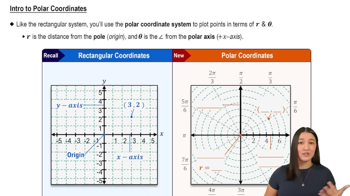
Rectangular coordinates (x, y) represent a point's position using horizontal and vertical distances from the origin. Polar coordinates (r, θ) describe the same point by its distance r from the origin and the angle θ formed with the positive x-axis, measured in radians.
Recommended video:
05:32
Intro to Polar Coordinates

Conversion Formulas Between Coordinates

To convert from rectangular to polar coordinates, use r = √(x² + y²) to find the radius and θ = arctan(y/x) to find the angle. Adjust θ based on the quadrant of the point to ensure the angle correctly represents the point's direction.
Recommended video:
05:32
Intro to Polar Coordinates

Angle Measurement in Radians and Quadrant Considerations

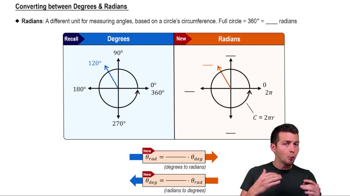
Angles in polar coordinates are measured in radians, where 2π radians equal 360°. Since arctan(y/x) returns values between -π/2 and π/2, you must consider the signs of x and y to determine the correct quadrant and adjust θ accordingly for an accurate angle.
Recommended video:
5:04
Converting between Degrees & Radians