Use a calculator to approximate each value in decimal degrees. θ = arcsec 3.4723155
Verified step by step guidance
1
Recall that the arcsecant function, \(\theta = \arcsec(x)\), is the inverse of the secant function, so \(\sec(\theta) = x\).
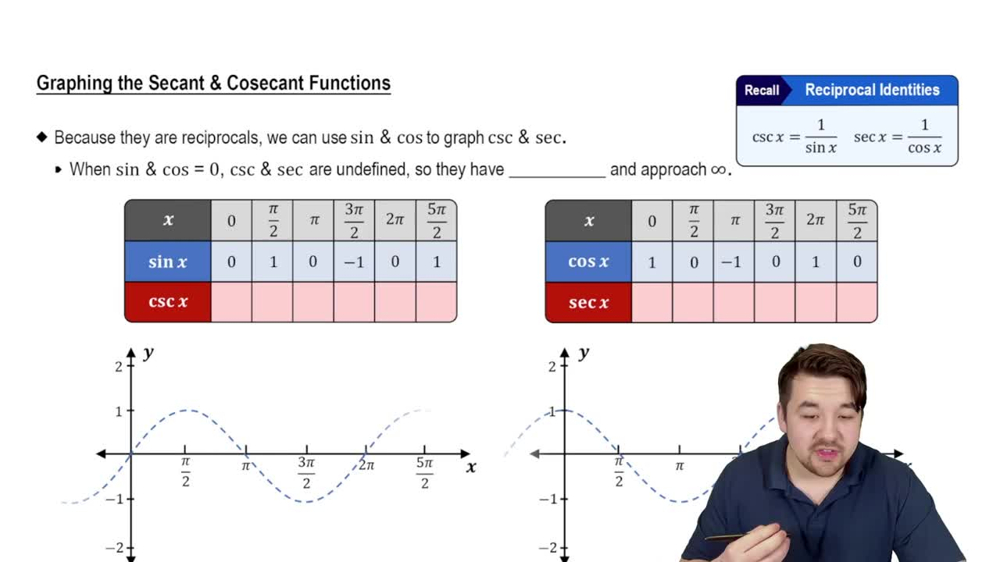
Rewrite the secant in terms of cosine: since \(\sec(\theta) = \frac{1}{\cos(\theta)}\), we have \(\cos(\theta) = \frac{1}{x}\).
Substitute the given value: \(\cos(\theta) = \frac{1}{3.4723155}\).
Use a calculator to find the angle \(\theta\) by taking the arccosine (inverse cosine) of \(\frac{1}{3.4723155}\), i.e., \(\theta = \arccos\left(\frac{1}{3.4723155}\right)\).
Make sure your calculator is set to degree mode to get the answer in decimal degrees.
Verified video answer for a similar problem:
This video solution was recommended by our tutors as helpful for the problem above
Play a video:
0 Comments
Key Concepts
Here are the essential concepts you must grasp in order to answer the question correctly.
Inverse Trigonometric Functions
Inverse trigonometric functions, like arcsecant (arcsec), are used to find the angle whose trigonometric ratio equals a given value. For arcsec, it returns the angle whose secant is the input number. Understanding how to interpret and use these functions is essential for solving problems involving angle measures.
The secant function, sec(θ), is the reciprocal of cosine: sec(θ) = 1/cos(θ). Its domain excludes angles where cosine is zero, and its range is |sec(θ)| ≥ 1. Recognizing these properties helps in understanding the valid input values for arcsec and the expected output angles.
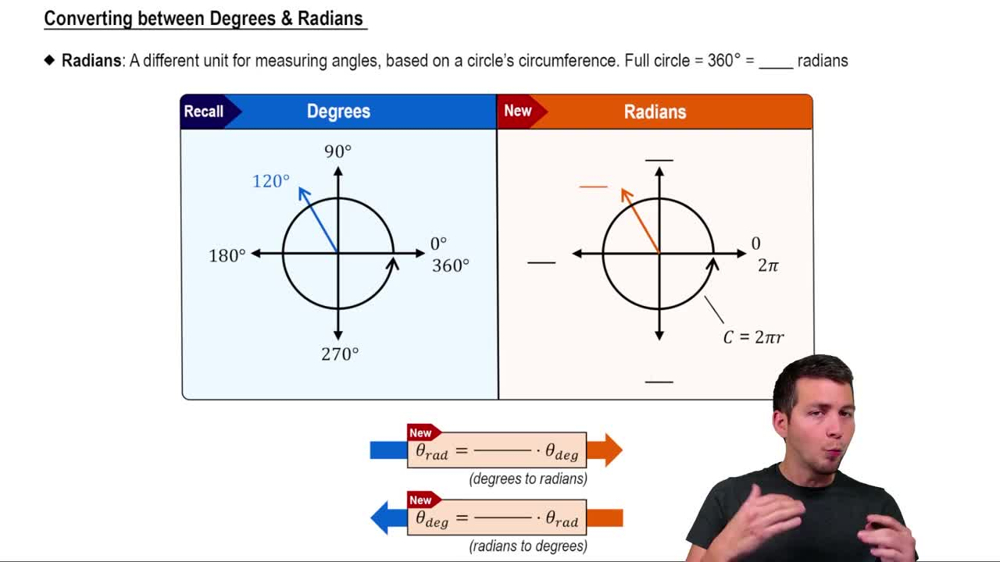
Calculators often return inverse trig function results in radians by default. To express the angle in decimal degrees, multiply the radian measure by 180/π. This conversion is crucial for interpreting the answer in the desired unit, especially when the problem specifies degrees.

 Verified step by step guidance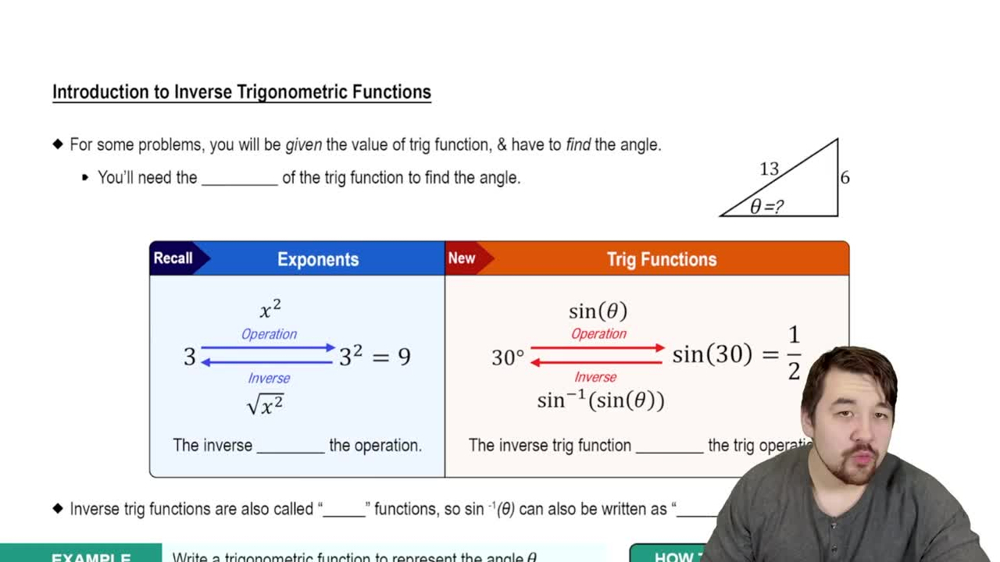
 4:28
4:28