Ch. 4 - Laws of Sines and Cosines; Vectors
Blitzer - Trigonometry 3rd Edition
Blitzer3rd EditionTrigonometryISBN: 9780137316601Not the one you use?Change textbook
Chapter 4, Problem 43

In Exercises 39–46, find the unit vector that has the same direction as the vector v.
v = 3i - 2j

Verified step by step guidance
1
Identify the given vector \( \mathbf{v} = 3\mathbf{i} - 2\mathbf{j} \). This means the vector components are \( (3, -2) \).
Calculate the magnitude (length) of the vector \( \mathbf{v} \) using the formula: \[ \\|\mathbf{v}\\| = \sqrt{(3)^2 + (-2)^2} = \sqrt{9 + 4} \]
Simplify the expression under the square root to find the magnitude: \[ \\|\mathbf{v}\\| = \sqrt{13} \]
To find the unit vector in the same direction as \( \mathbf{v} \), divide each component of \( \mathbf{v} \) by its magnitude: \[ \mathbf{u} = \left( \frac{3}{\\|\mathbf{v}\\|}, \frac{-2}{\\|\mathbf{v}\\|} \right) \]
Write the unit vector explicitly as: \[ \mathbf{u} = \left( \frac{3}{\sqrt{13}}, -\frac{2}{\sqrt{13}} \right) \] which is the vector with length 1 pointing in the same direction as \( \mathbf{v} \).

Verified video answer for a similar problem:

This video solution was recommended by our tutors as helpful for the problem above.
Video duration:
4m
Was this helpful?

Key Concepts

Here are the essential concepts you must grasp in order to answer the question correctly.

Vector Components and Notation

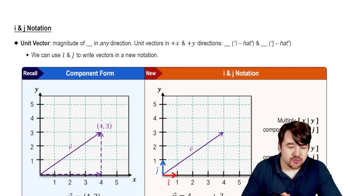
A vector in two dimensions can be expressed using unit vectors i and j, representing the x and y directions respectively. For example, v = 3i - 2j means the vector has an x-component of 3 and a y-component of -2. Understanding this notation is essential for manipulating and analyzing vectors.
Recommended video:
06:01
i & j Notation

Magnitude of a Vector

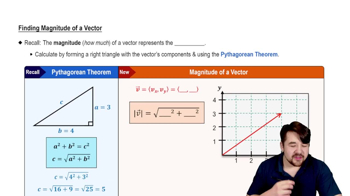
The magnitude (or length) of a vector v = ai + bj is found using the Pythagorean theorem: |v| = √(a² + b²). This scalar value represents the distance from the origin to the point defined by the vector components and is crucial for normalizing vectors.
Recommended video:
04:44
Finding Magnitude of a Vector

Unit Vector and Normalization

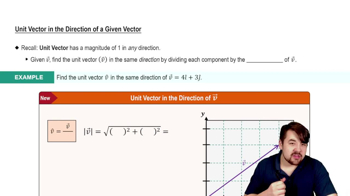
A unit vector has a magnitude of 1 and points in the same direction as the original vector. To find it, divide each component of the vector by its magnitude. This process, called normalization, produces a vector that preserves direction but standardizes length.
Recommended video:
04:04
Unit Vector in the Direction of a Given Vector