Write each rational expression in lowest terms. See Example 2.m² - 4m + 4 m² + m - 6
Verified step by step guidance
1
Factor the numerator \( m^2 - 4m + 4 \) as a perfect square trinomial.
Recognize that \( m^2 - 4m + 4 \) can be factored into \((m - 2)^2\).
Factor the denominator \( m^2 + m - 6 \) by finding two numbers that multiply to -6 and add to 1.
Identify that \( m^2 + m - 6 \) can be factored into \((m - 2)(m + 3)\).
Simplify the expression by canceling the common factor \((m - 2)\) from the numerator and the denominator.
Verified video answer for a similar problem:
This video solution was recommended by our tutors as helpful for the problem above
Video duration:
4m
Play a video:
0 Comments
Key Concepts
Here are the essential concepts you must grasp in order to answer the question correctly.
Factoring Quadratic Expressions
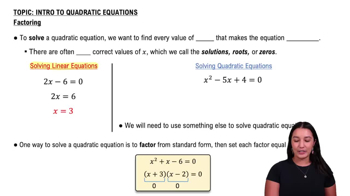
Factoring is the process of breaking down a quadratic expression into simpler components, typically in the form of two binomials. For example, the expression m² - 4m + 4 can be factored as (m - 2)(m - 2) or (m - 2)². This step is crucial for simplifying rational expressions, as it allows for the identification of common factors.
A rational expression is in lowest terms when the numerator and denominator have no common factors other than 1. To simplify a rational expression, one must factor both the numerator and denominator and then cancel out any common factors. This process ensures that the expression is as simplified as possible, making it easier to work with in further calculations.
Identifying common factors involves recognizing elements that appear in both the numerator and denominator of a rational expression. This is essential for simplification, as it allows for the cancellation of these factors. For instance, if both the numerator and denominator share a factor of (m - 2), it can be eliminated, leading to a simpler expression.