Exercises 39–52 involve trigonometric equations quadratic in form. Solve each equation on the interval [0, 2𝝅). 2 cos² x + 3 cos x + 1 = 0
Verified step by step guidance
1
Recognize that the equation is quadratic in form with respect to \( \cos x \). Let \( u = \cos x \), so the equation becomes \( 2u^{2} + 3u + 1 = 0 \).
Solve the quadratic equation \( 2u^{2} + 3u + 1 = 0 \) using the quadratic formula: \( u = \frac{-b \pm \sqrt{b^{2} - 4ac}}{2a} \), where \( a=2 \), \( b=3 \), and \( c=1 \).
Calculate the discriminant \( \Delta = b^{2} - 4ac = 3^{2} - 4 \times 2 \times 1 \) and then find the two possible values for \( u = \cos x \).
For each value of \( \cos x \) found, determine the corresponding values of \( x \) in the interval \( [0, 2\pi) \) by using the inverse cosine function: \( x = \arccos(u) \) and considering the symmetry of cosine in the unit circle.
Write down all solutions \( x \) in \( [0, 2\pi) \) that satisfy the original equation, ensuring to check if any values of \( u \) are outside the valid range for cosine (i.e., \( -1 \leq u \leq 1 \)) and discard those if necessary.
Verified video answer for a similar problem:
This video solution was recommended by our tutors as helpful for the problem above
Video duration:
11m
Play a video:
0 Comments
Key Concepts
Here are the essential concepts you must grasp in order to answer the question correctly.
Quadratic Form in Trigonometric Equations
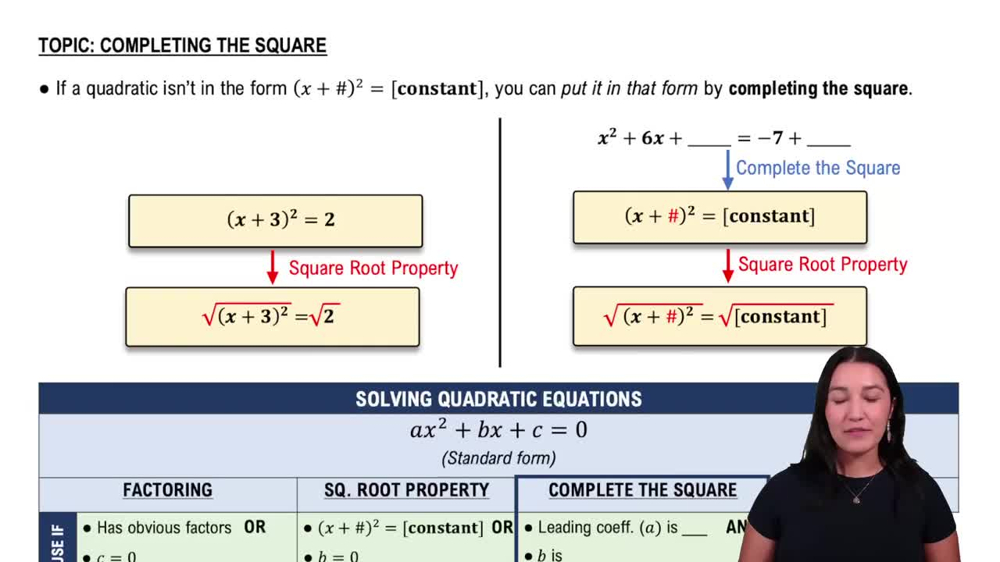
Some trigonometric equations can be rewritten as quadratic equations by substituting a trigonometric function (e.g., cos x) with a variable. This allows the use of algebraic methods like factoring or the quadratic formula to find solutions for the trigonometric function.
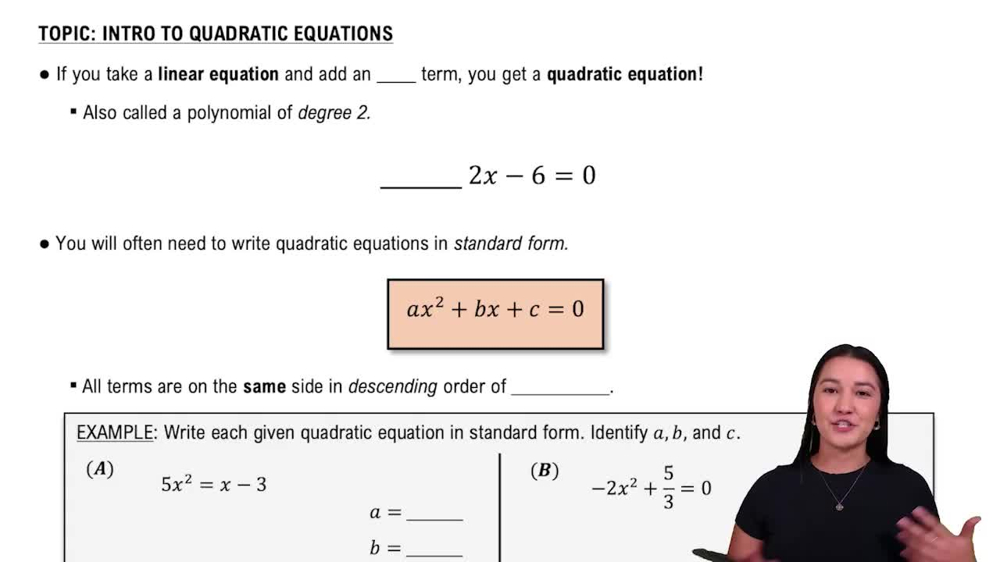
Solving quadratic equations involves finding values of the variable that satisfy the equation, typically by factoring, completing the square, or using the quadratic formula. These solutions correspond to values of the trigonometric function in the original equation.
Solving Quadratic Equations by Completing the Square
Finding Angles from Trigonometric Values on a Given Interval
After determining the values of the trigonometric function, you find all angles x within the specified interval [0, 2π) that satisfy these values. This requires understanding the unit circle and the periodic nature of trigonometric functions to identify all valid solutions.

 11:12 minutes
 Verified step by step guidance
 5:35
5:35