In Exercises 79–82, graph f, g, and h in the same rectangular coordinate system for 0 ≤ x ≤ 2π. Obtain the graph of h by adding or subtracting the corresponding y-coordinates on the graphs of f and g.f(x) = 2 cos x, g(x) = cos 2x, h(x) = (f + g)(x)
Verified step by step guidance
1
Step 1: Identify the functions to be graphed. We have three functions: \( f(x) = 2 \cos x \), \( g(x) = \cos 2x \), and \( h(x) = (f + g)(x) \).
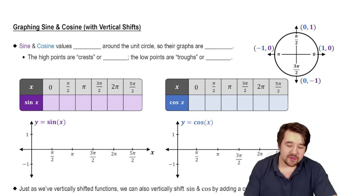
Step 2: Graph \( f(x) = 2 \cos x \) over the interval \( 0 \leq x \leq 2\pi \). This is a cosine wave with an amplitude of 2.
Step 3: Graph \( g(x) = \cos 2x \) over the same interval. This function has a period of \( \pi \) and an amplitude of 1, so it completes two full cycles between \( 0 \) and \( 2\pi \).
Step 4: To find \( h(x) = (f + g)(x) \), add the corresponding y-coordinates of \( f(x) \) and \( g(x) \) for each x-value in the interval \( 0 \leq x \leq 2\pi \).
Step 5: Graph \( h(x) \) using the y-coordinates obtained from the addition in Step 4. This will show the combined effect of \( f(x) \) and \( g(x) \) on the same coordinate system.
Verified video answer for a similar problem:

This video solution was recommended by our tutors as helpful for the problem above
Video duration:
6m
Play a video:
0 Comments
Key Concepts
Here are the essential concepts you must grasp in order to answer the question correctly.
Trigonometric Functions
Trigonometric functions, such as sine and cosine, are fundamental in trigonometry, representing relationships between angles and sides of triangles. In this context, f(x) = 2 cos x and g(x) = cos 2x are specific trigonometric functions that will be graphed. Understanding their periodic nature and amplitude is crucial for accurately plotting their graphs.
Graphing functions involves plotting points on a coordinate system to visualize the behavior of the function over a specified interval. For the given functions f and g, it is essential to determine key features such as intercepts, maxima, minima, and periodicity. This visual representation aids in understanding how the functions interact when combined to form h(x).
The process of adding or subtracting functions involves combining their outputs for corresponding inputs. In this case, h(x) = (f + g)(x) means that for each x-value, the y-coordinates of f and g are added together. This concept is vital for determining the resulting graph of h, as it reflects the combined effects of the individual functions on the overall output.