Match each function with its graph in choices A–F.
y = tan (x - π )
A. <IMAGE> B. <IMAGE> C. <IMAGE>
D. <IMAGE> E. <IMAGE> F. <IMAGE>
Verified step by step guidance
1
Recall the general shape and properties of the tangent function \(y = \tan x\), including its period \(\pi\), vertical asymptotes at \(x = \frac{\pi}{2} + k\pi\) for integers \(k\), and zeros at \(x = k\pi\).
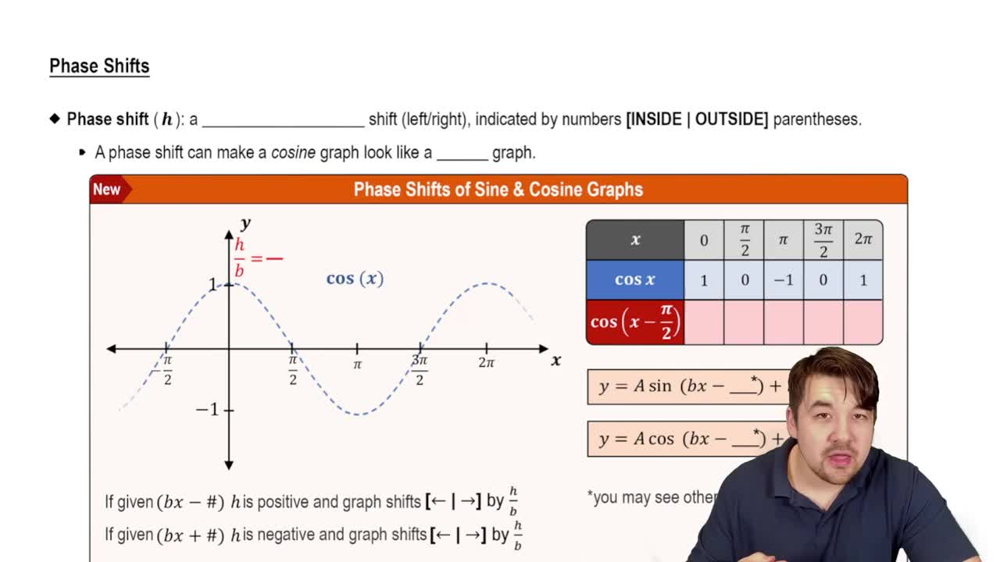
Understand that the function \(y = \tan(x - \pi)\) represents a horizontal shift of the basic tangent function to the right by \(\pi\) units.
Determine the new locations of the vertical asymptotes and zeros after the shift: vertical asymptotes occur where \(x - \pi = \frac{\pi}{2} + k\pi\), so \(x = \frac{\pi}{2} + \pi + k\pi = \frac{3\pi}{2} + k\pi\), and zeros occur where \(x - \pi = k\pi\), so \(x = \pi + k\pi\).
Compare these shifted features (asymptotes and zeros) with the graphs in choices A–F to identify which graph matches the function \(y = \tan(x - \pi)\).
Confirm that the shape and orientation of the graph correspond to the tangent function's increasing behavior between asymptotes and that the period remains \(\pi\).
Verified video answer for a similar problem:
This video solution was recommended by our tutors as helpful for the problem above
Play a video:
0 Comments
Key Concepts
Here are the essential concepts you must grasp in order to answer the question correctly.
Properties of the Tangent Function
The tangent function, tan(x), is periodic with period π and has vertical asymptotes where cos(x) = 0, at x = ±π/2, ±3π/2, etc. Its graph repeats every π units and passes through the origin with increasing values between asymptotes. Understanding these properties helps identify the shape and key features of tan(x) graphs.
A horizontal phase shift occurs when the input variable x is replaced by (x - c), shifting the graph c units to the right. For y = tan(x - π), the entire tangent graph shifts π units right, moving asymptotes and intercepts accordingly. Recognizing phase shifts is essential for matching transformed graphs to their functions.
Matching a trigonometric function to its graph requires analyzing key features like period, amplitude (if applicable), asymptotes, intercepts, and shifts. For tangent functions, focus on vertical asymptotes and zero crossings. Comparing these features with given graphs allows accurate identification of the correct match.

 Verified step by step guidance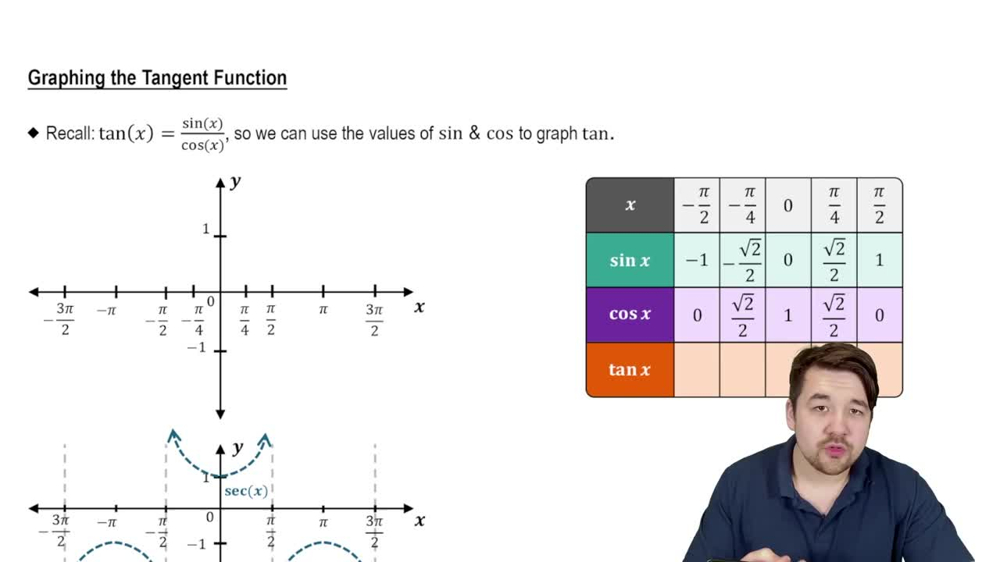
 5:43
5:43