Evaluate each expression.
Table of contents
- 0. Review of College Algebra4h 45m
- 1. Measuring Angles40m
- 2. Trigonometric Functions on Right Triangles2h 5m
- 3. Unit Circle1h 19m
- 4. Graphing Trigonometric Functions1h 19m
- 5. Inverse Trigonometric Functions and Basic Trigonometric Equations1h 41m
- 6. Trigonometric Identities and More Equations2h 34m
- 7. Non-Right Triangles1h 38m
- 8. Vectors2h 25m
- 9. Polar Equations2h 5m
- 10. Parametric Equations1h 6m
- 11. Graphing Complex Numbers1h 7m
3. Unit Circle
Reciprocal Trigonometric Functions on the Unit Circle
Problem 30a
Textbook Question
In Exercises 25β32, the unit circle has been divided into eight equal arcs, corresponding to t-values of
0, π/4, π/2, 3π/4, π, 5π/4, 3π/2, 7π/4, and 2π.
a. Use the (x,y) coordinates in the figure to find the value of the trigonometric function.
b. Use periodic properties and your answer from part (a) to find the value of the same trigonometric function at the indicated real number.
<IMAGE>
cot π/2
Verified step by step guidance1
Step 1: Understand the problem context. The problem involves the unit circle divided into eight equal arcs, each corresponding to specific t-values (angles) measured in radians. The goal is to find the value of the trigonometric function cotangent at \( \frac{\pi}{2} \).
Step 2: Recall the definition of cotangent in terms of coordinates on the unit circle. For an angle \( t \), the coordinates on the unit circle are \( (x, y) = (\cos t, \sin t) \). The cotangent function is defined as \( \cot t = \frac{\cos t}{\sin t} = \frac{x}{y} \).
Step 3: Identify the coordinates at \( t = \frac{\pi}{2} \) on the unit circle. At this angle, the point on the unit circle is \( (x, y) = (\cos \frac{\pi}{2}, \sin \frac{\pi}{2}) \). Use these coordinates to express \( \cot \frac{\pi}{2} = \frac{\cos \frac{\pi}{2}}{\sin \frac{\pi}{2}} \).
Step 4: Use the periodic properties of the cotangent function to find its value at other angles if needed. Cotangent has a period of \( \pi \), so \( \cot(t + \pi) = \cot t \). This property helps to find cotangent values at angles beyond the first revolution by relating them back to known values.
Step 5: Apply the above steps to evaluate \( \cot \frac{\pi}{2} \) and then use periodicity if asked to find cotangent at other indicated real numbers.
Verified video answer for a similar problem:This video solution was recommended by our tutors as helpful for the problem above
Video duration:
2mPlay a video:
0 Comments
Key Concepts
Here are the essential concepts you must grasp in order to answer the question correctly.
Unit Circle and Angle Measurement
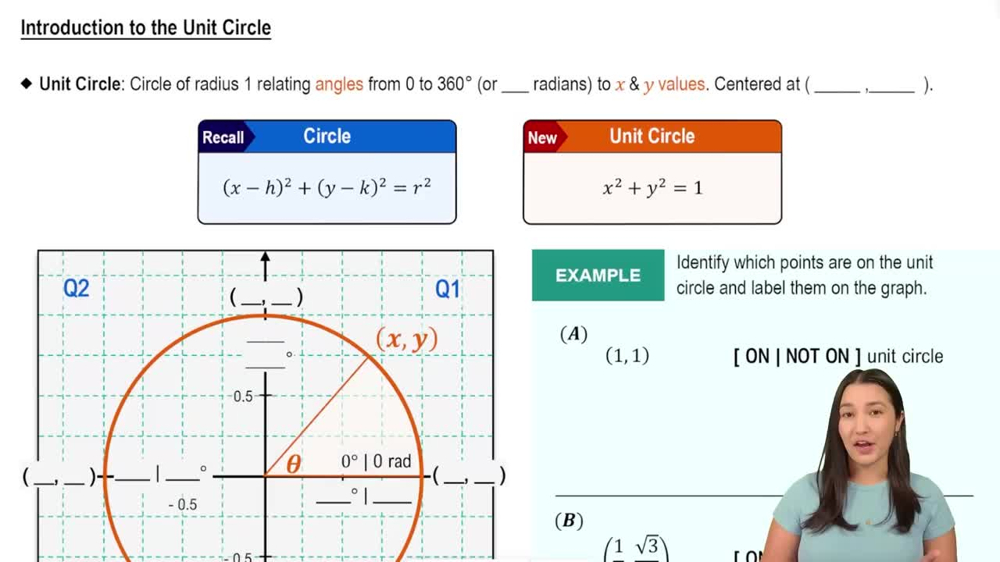
The unit circle is a circle with radius 1 centered at the origin of the coordinate plane. Angles measured in radians correspond to points on the circle, where the x-coordinate is cos(ΞΈ) and the y-coordinate is sin(ΞΈ). Understanding how angles divide the circle into arcs helps locate points and evaluate trigonometric functions.
Recommended video:
Introduction to the Unit Circle
Definition of Cotangent Function
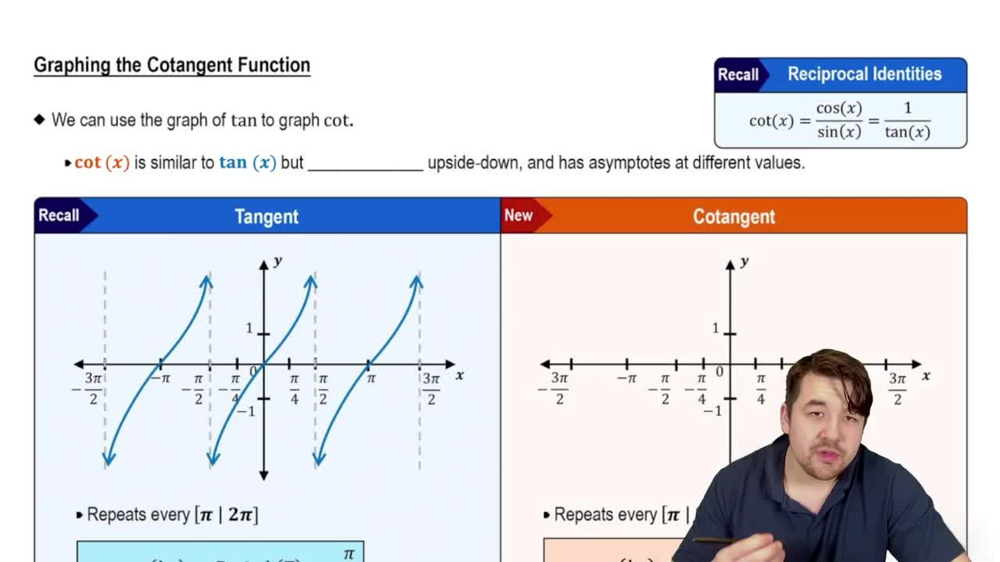
Cotangent (cot ΞΈ) is the ratio of the cosine to the sine of an angle, cot ΞΈ = cos ΞΈ / sin ΞΈ. It is undefined where sin ΞΈ = 0, such as at ΞΈ = 0 or Ο. Knowing this ratio and its domain restrictions is essential for evaluating cotangent values at specific angles on the unit circle.
Recommended video:
Introduction to Cotangent Graph
Periodic Properties of Trigonometric Functions
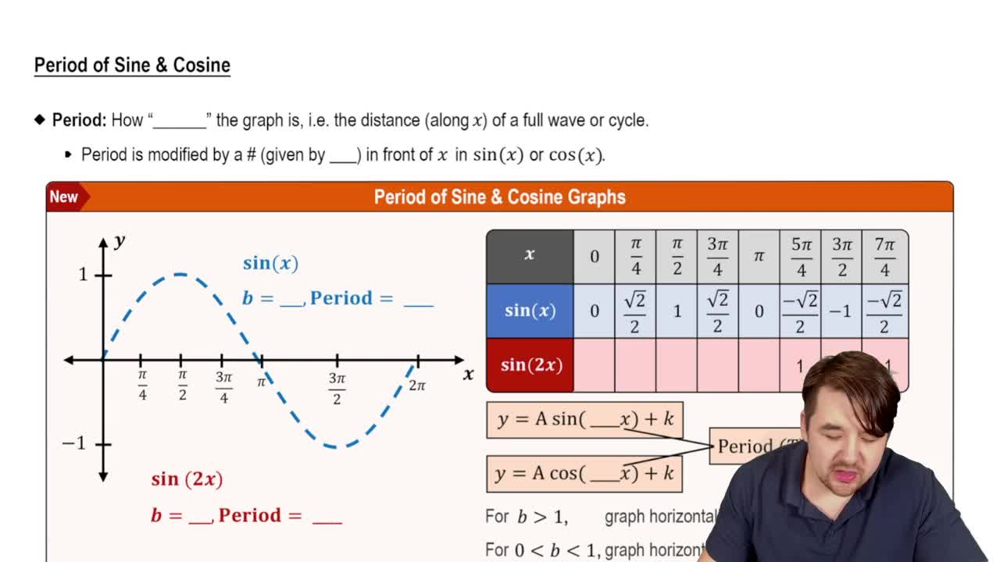
Trigonometric functions repeat their values in regular intervals called periods. For cotangent, the period is Ο, meaning cot(ΞΈ + Ο) = cot ΞΈ. This property allows finding function values at angles beyond the initial interval by relating them back to known values within one period.
Recommended video:
Period of Sine and Cosine Functions
Related Videos
Related Practice
Multiple Choice
415
views