Ch. 5 - Trigonometric Identities
Lial - Trigonometry 12th Edition
Lial12th EditionTrigonometryISBN: 9780136552161Not the one you use?Change textbook
Chapter 6, Problem 38

Simplify each expression.
sin 158.2°/(1 + cos 158.2°)

Verified step by step guidance
1
Recognize that the expression \( \frac{\sin 158.2^\circ}{1 + \cos 158.2^\circ} \) can be simplified using trigonometric identities related to half-angle formulas or sum-to-product formulas.
Recall the identity for tangent of half an angle: \( \tan \frac{\theta}{2} = \frac{\sin \theta}{1 + \cos \theta} \). This matches the form of the given expression.
Apply the identity by setting \( \theta = 158.2^\circ \), so the expression simplifies to \( \tan \frac{158.2^\circ}{2} \).
Calculate the half-angle: \( \frac{158.2^\circ}{2} = 79.1^\circ \), so the expression becomes \( \tan 79.1^\circ \).
Thus, the simplified form of the original expression is \( \tan 79.1^\circ \).

Verified video answer for a similar problem:

This video solution was recommended by our tutors as helpful for the problem above.
Was this helpful?

Key Concepts

Here are the essential concepts you must grasp in order to answer the question correctly.

Trigonometric Identities

Trigonometric identities are equations involving trigonometric functions that hold true for all angle values. Key identities like the Pythagorean identity and angle sum/difference formulas help simplify expressions by rewriting them in more manageable forms.
Recommended video:
5:32
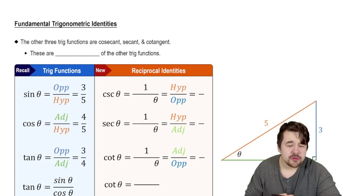
Fundamental Trigonometric Identities

Half-Angle and Sum/Difference Formulas

Half-angle and sum/difference formulas allow the expression of trigonometric functions of certain angles in terms of other angles. These formulas are useful for simplifying expressions involving angles that are not standard, such as 158.2°, by relating them to more familiar angles.
Recommended video:
2:25
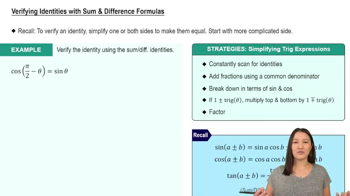
Verifying Identities with Sum and Difference Formulas

Simplification of Rational Trigonometric Expressions

Simplifying rational expressions involving sine and cosine often involves factoring, using identities, or converting the expression into a single trigonometric function. Recognizing patterns like sin θ / (1 + cos θ) can lead to simpler forms such as tangent of half the angle.
Recommended video:
2:58
Rationalizing Denominators