Identify the number inside the square root: here it is 75.
Factor 75 into its prime factors or into a product of a perfect square and another number. For example, 75 can be factored as \(75 = 25 \times 3\).
Use the property of square roots that \(\sqrt{a \times b} = \sqrt{a} \times \sqrt{b}\) to rewrite \(\sqrt{75}\) as \(\sqrt{25 \times 3} = \sqrt{25} \times \sqrt{3}\).
Simplify the square root of the perfect square: \(\sqrt{25} = 5\).
Write the simplified form as \(5 \sqrt{3}\), which is the simplified radical form of \(\sqrt{75}\).
Verified video answer for a similar problem:
This video solution was recommended by our tutors as helpful for the problem above
Video duration:
1m
Play a video:
0 Comments
Key Concepts
Here are the essential concepts you must grasp in order to answer the question correctly.
Simplifying Radicals
Simplifying radicals involves expressing a square root in its simplest form by factoring the radicand into perfect squares and other factors. For example, √75 can be broken down into √(25 × 3), which simplifies to 5√3 because √25 is 5.
Perfect squares are numbers that are squares of integers, such as 1, 4, 9, 16, 25, etc. Recognizing perfect squares within a radicand helps simplify radicals by extracting these square roots as whole numbers.
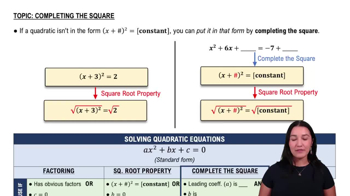
Solving Quadratic Equations by Completing the Square
Properties of Square Roots
The property √(a × b) = √a × √b allows the separation of a square root of a product into the product of square roots. This property is essential for breaking down complex radicals into simpler parts for easier simplification.

 1:49 minutes
 Verified step by step guidance

 6:36
6:36