Identify the largest perfect square factor of 75. The perfect squares less than 75 are 1, 4, 9, 16, 25, 36, 49, and 64. The largest perfect square factor of 75 is 25.
Express 75 as a product of its largest perfect square factor and another factor: \( 75 = 25 \times 3 \).
Use the property of square roots that \( \sqrt{a \times b} = \sqrt{a} \times \sqrt{b} \) to separate the square root: \( \sqrt{75} = \sqrt{25 \times 3} = \sqrt{25} \times \sqrt{3} \).
Simplify \( \sqrt{25} \) to 5, since 25 is a perfect square: \( \sqrt{25} = 5 \).
This video solution was recommended by our tutors as helpful for the problem above
Video duration:
1m
Play a video:
0 Comments
Key Concepts
Here are the essential concepts you must grasp in order to answer the question correctly.
Radical Simplification
Radical simplification involves rewriting a radical expression in its simplest form. This typically means factoring out perfect squares from under the radical sign. For example, √75 can be simplified by recognizing that 75 = 25 × 3, allowing us to express √75 as √(25 × 3) = √25 × √3 = 5√3.
Perfect squares are numbers that can be expressed as the square of an integer. Common perfect squares include 1, 4, 9, 16, 25, and so on. Identifying perfect squares within a radical is crucial for simplification, as they can be taken out of the radical, making calculations easier and the expression neater.
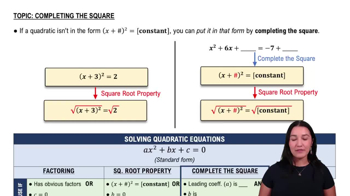
Solving Quadratic Equations by Completing the Square
Properties of Radicals
The properties of radicals include rules that govern how to manipulate radical expressions. Key properties include the product property (√a × √b = √(a × b)) and the quotient property (√a / √b = √(a / b)). Understanding these properties is essential for simplifying radicals effectively and performing operations involving them.

 1:49 minutes
 Verified step by step guidance
 6:20
6:20