Ch. 2 - Acute Angles and Right Triangles
Lial - Trigonometry 12th Edition
Lial12th EditionTrigonometryISBN: 9780136552161Not the one you use?Change textbook
Chapter 3, Problem 58

Solve each problem. (Source for Exercises 49 and 50: Parker, M., Editor, She Does Math, Mathematical Association of America.) Find a formula for h in terms of k, A, and B. Assume A < B.
Right triangle with angles A and B, base k, and height h labeled, illustrating trigonometric relationships.

Verified step by step guidance
1
Identify the given variables and what is asked: we need to express \( h \) in terms of \( k \), \( A \), and \( B \), with the condition \( A < B \).
Recall the relevant trigonometric relationships or formulas that connect these variables. Since \( A \) and \( B \) are angles and \( h \) and \( k \) are lengths, consider using the Law of Sines or Law of Cosines depending on the context.
Set up an equation involving \( h \), \( k \), \( A \), and \( B \). For example, if \( h \) and \( k \) are sides opposite angles \( A \) and \( B \) respectively, the Law of Sines states: \[\frac{h}{\sin(\doublebackslash A)} = \frac{k}{\sin(\doublebackslash B)}\]
Solve this equation for \( h \) to express it explicitly in terms of \( k \), \( A \), and \( B \). This involves multiplying both sides by \( \sin(\doublebackslash A) \): \[h = k \cdot \frac{\sin(\doublebackslash A)}{\sin(\doublebackslash B)}\]
Verify the formula makes sense given the condition \( A < B \), and ensure all variables are correctly placed to represent the relationship between \( h \), \( k \), \( A \), and \( B \).

Verified video answer for a similar problem:

This video solution was recommended by our tutors as helpful for the problem above.
Video duration:
5m
Was this helpful?

Key Concepts

Here are the essential concepts you must grasp in order to answer the question correctly.

Trigonometric Functions and Their Relationships

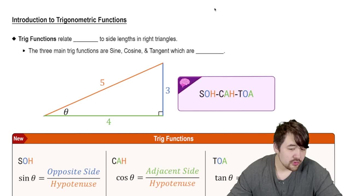
Understanding sine, cosine, and tangent functions is essential, as they relate angles to side lengths in right triangles. These functions allow expressing one side length in terms of angles and other sides, which is crucial for deriving formulas involving variables like h, k, A, and B.
Recommended video:
6:04
Introduction to Trigonometric Functions

Angle Inequalities and Their Implications

The condition A < B indicates a relationship between angles that affects the relative lengths of sides opposite these angles. Recognizing how inequalities between angles influence side lengths helps in setting up correct equations and ensuring the formula for h is consistent with the given constraints.
Recommended video:
04:46
Coterminal Angles

Formulating and Solving Trigonometric Equations

Deriving a formula for h in terms of k, A, and B requires setting up equations based on trigonometric identities and solving for the unknown variable. This involves manipulating expressions, applying inverse functions if needed, and isolating h to express it explicitly in terms of the given parameters.
Recommended video:
4:34
How to Solve Linear Trigonometric Equations