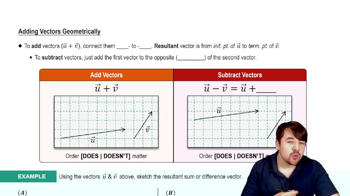
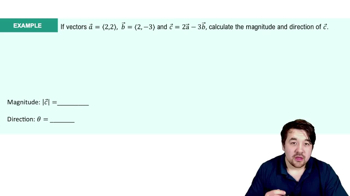
Use the figure to find each vector: u - v. Use vector notation as in Example 4.
<IMAGE>
Verified step by step guidance
1
Identify the components of vector \( \mathbf{u} \) and vector \( \mathbf{v} \) from the given figure.
Express vector \( \mathbf{u} \) in component form as \( \langle u_1, u_2 \rangle \).
Express vector \( \mathbf{v} \) in component form as \( \langle v_1, v_2 \rangle \).
Subtract the components of vector \( \mathbf{v} \) from vector \( \mathbf{u} \) to find \( \mathbf{u} - \mathbf{v} \), resulting in \( \langle u_1 - v_1, u_2 - v_2 \rangle \).
Write the resulting vector \( \mathbf{u} - \mathbf{v} \) in vector notation.
Verified video answer for a similar problem:
This video solution was recommended by our tutors as helpful for the problem above
Play a video:
0 Comments
Key Concepts
Here are the essential concepts you must grasp in order to answer the question correctly.
Vector Notation
Vector notation is a way to represent vectors in a mathematical format, typically using angle brackets. For example, a vector u can be expressed as u = <u1, u2>, where u1 and u2 are its components along the x and y axes. Understanding this notation is essential for performing vector operations, such as addition and subtraction.
Vector subtraction involves finding the difference between two vectors, which is done by subtracting their corresponding components. If u = <u1, u2> and v = <v1, v2>, then the vector u - v is calculated as <u1 - v1, u2 - v2>. This concept is crucial for solving problems that require determining the resultant vector from two given vectors.
Graphical representation of vectors involves illustrating vectors as arrows in a coordinate system, where the direction and length of the arrow represent the vector's direction and magnitude, respectively. This visual aid helps in understanding vector operations, such as addition and subtraction, by allowing one to see how vectors interact spatially.

 Verified step by step guidance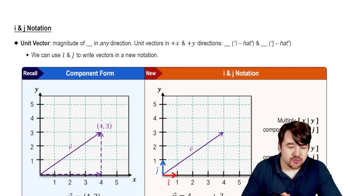
 06:01
06:01