Ch. 5 - Trigonometric Identities
Lial - Trigonometry 12th Edition
Lial12th EditionTrigonometryISBN: 9780136552161Not the one you use?Change textbook
Chapter 6, Problem 34

Write each function as an expression involving functions of θ or x alone. See Example 2.
cos(θ - 30°)

Verified step by step guidance
1
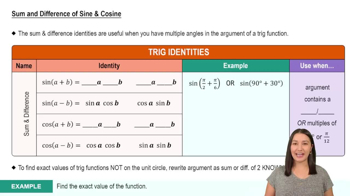
Recall the cosine difference identity: \(\cos(a - b) = \cos a \cos b + \sin a \sin b\).
Identify the angles in the expression: here, \(a = \theta\) and \(b = 30^\circ\).
Apply the identity to rewrite \(\cos(\theta - 30^\circ)\) as \(\cos \theta \cos 30^\circ + \sin \theta \sin 30^\circ\).
Substitute the exact values for \(\cos 30^\circ\) and \(\sin 30^\circ\): \(\cos 30^\circ = \frac{\sqrt{3}}{2}\) and \(\sin 30^\circ = \frac{1}{2}\).
Write the final expression as \(\cos \theta \cdot \frac{\sqrt{3}}{2} + \sin \theta \cdot \frac{1}{2}\), which involves functions of \(\theta\) alone.

Verified video answer for a similar problem:

This video solution was recommended by our tutors as helpful for the problem above.
Was this helpful?

Key Concepts

Here are the essential concepts you must grasp in order to answer the question correctly.

Angle Difference Identity for Cosine

The angle difference identity states that cos(α - β) = cos α cos β + sin α sin β. This formula allows expressing the cosine of a difference of two angles as a combination of sines and cosines of the individual angles, which is essential for rewriting cos(θ - 30°) in terms of cos θ and sin θ.
Recommended video:
06:14
Sum and Difference of Sine & Cosine

Trigonometric Functions of Special Angles

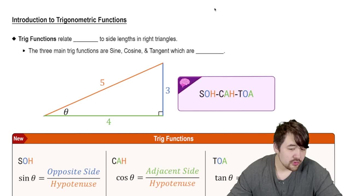
Special angles like 30°, 45°, and 60° have known exact sine and cosine values. For 30°, cos 30° = √3/2 and sin 30° = 1/2. Using these values simplifies expressions involving these angles, enabling the conversion of cos(θ - 30°) into a function involving θ alone.
Recommended video:
6:04
Introduction to Trigonometric Functions

Function Notation and Variable Dependence

Understanding that trigonometric functions can be expressed as functions of a single variable (θ or x) is crucial. This means rewriting expressions so that all terms depend only on θ, facilitating further manipulation or evaluation without ambiguity about the variables involved.
Recommended video:
06:01
i & j Notation