Recognize that the expression involves the absolute value function and a negative sign: \(- |5|\).
Recall that the absolute value of a number is its distance from zero on the number line, which is always non-negative. So, \(|5| = 5\).
Substitute the absolute value back into the expression: \(- |5| = -5\).
Understand that the negative sign outside the absolute value changes the sign of the result from positive to negative.
Therefore, the expression simplifies to \(-5\).
Verified video answer for a similar problem:
This video solution was recommended by our tutors as helpful for the problem above
Play a video:
0 Comments
Key Concepts
Here are the essential concepts you must grasp in order to answer the question correctly.
Absolute Value
The absolute value of a number is its distance from zero on the number line, always expressed as a non-negative value. For example, |5| equals 5, and |-5| also equals 5. It essentially removes any negative sign from the number.
Evaluate Composite Functions - Values Not on Unit Circle
Evaluating Expressions
Evaluating an expression means calculating its value by following mathematical operations and rules. In this case, evaluating |-5| involves applying the absolute value operation to the number -5 to find its magnitude.
Understanding properties of real numbers, such as the fact that absolute value outputs are always non-negative, helps in correctly interpreting and simplifying expressions. This ensures accurate evaluation of expressions involving absolute values.

 Verified step by step guidance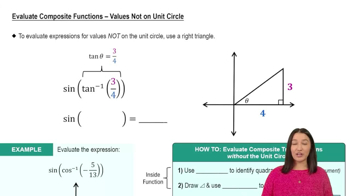
 7:28
7:28