
(Modeling) Grade Resistance Solve each problem. See Example 3. A 3000-lb car traveling uphill has a grade resistance of 150 lb. Find the angle of the grade to the nearest tenth of a degree.
Use a calculator to approximate the value of each expression. Give answers to six decimal places. In Exercises 21–28, simplify the expression before using the calculator. See Example 1.
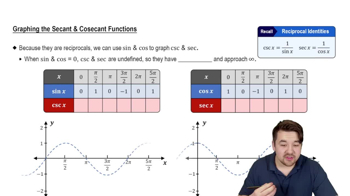
1/ sec 14.8°
Verified step by step guidance
Verified video answer for a similar problem:
Key Concepts
Understanding the Secant Function
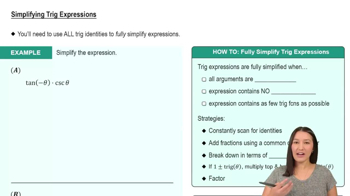
Simplifying Trigonometric Expressions
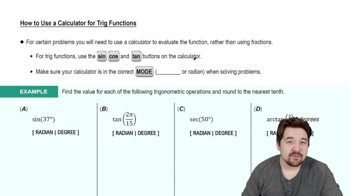
Using a Calculator for Trigonometric Values
Use a calculator to determine whether each statement is true or false. A true statement may lead to results that differ in the last decimal place due to rounding error. sin 10° + sin 10° = sin 20°
(Modeling) Grade Resistance Solve each problem. See Example 3. A car traveling on a -3° downhill grade has a grade resistance of -145 lb. Determine the weight of the car to the nearest hundred pounds.
Solve each problem. See Examples 1 and 2. Distance Traveled by a Ship A ship travels 55 km on a bearing of 27° and then travels on a bearing of 117° for 140 km. Find the distance from the starting point to the ending point.
Find two angles in the interval [0°, 360°) that satisfy each of the following. Round answers to the nearest degree. sin θ = 0.52991926
Find a value of θ in the interval [0°, 90°) that satisfies each statement. Give answers in decimal degrees to six decimal places. See Example 2.
sin θ = 0.84802194
