Ch. 6 - Inverse Circular Functions and Trigonometric Equations
Lial - Trigonometry 12th Edition
Lial12th EditionTrigonometryISBN: 9780136552161Not the one you use?Change textbook
Chapter 7, Problem 31

Solve each equation for exact solutions.
cos⁻¹ x = sin⁻¹ 3/5

Verified step by step guidance
1
Recognize that the equation is \(\cos^{-1} x = \sin^{-1} \frac{3}{5}\), where \(\cos^{-1} x\) and \(\sin^{-1} \frac{3}{5}\) represent inverse cosine and inverse sine functions respectively.
Recall the identity relating inverse sine and inverse cosine: for any angle \(\theta\), \(\cos^{-1} x = \sin^{-1} y\) implies \(x = \cos(\sin^{-1} y)\).
Use the Pythagorean identity to express \(\cos(\sin^{-1} y)\) in terms of \(y\): since \(\sin^2 \theta + \cos^2 \theta = 1\), then \(\cos(\sin^{-1} y) = \sqrt{1 - y^2}\) (considering the principal value range).
Substitute \(y = \frac{3}{5}\) into the expression to get \(x = \sqrt{1 - \left(\frac{3}{5}\right)^2}\).
Simplify the expression under the square root to find the exact value of \(x\).

Verified video answer for a similar problem:

This video solution was recommended by our tutors as helpful for the problem above.
Was this helpful?

Key Concepts

Here are the essential concepts you must grasp in order to answer the question correctly.

Inverse Trigonometric Functions

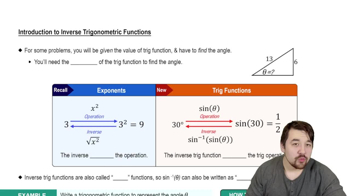
Inverse trigonometric functions, such as cos⁻¹ (arccos) and sin⁻¹ (arcsin), return the angle whose cosine or sine is a given value. They are used to find angles from known trigonometric ratios and have specific ranges to ensure unique outputs.
Recommended video:
4:28
Introduction to Inverse Trig Functions

Relationship Between Sine and Cosine

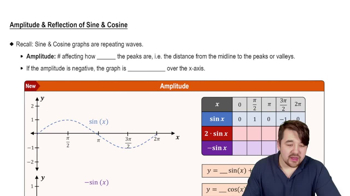
Sine and cosine of complementary angles are related by the identity cos(θ) = sin(90° - θ) or cos(θ) = sin(π/2 - θ). This relationship helps in converting between inverse sine and inverse cosine expressions to find exact angle values.
Recommended video:
5:05
Amplitude and Reflection of Sine and Cosine

Solving Trigonometric Equations for Exact Values

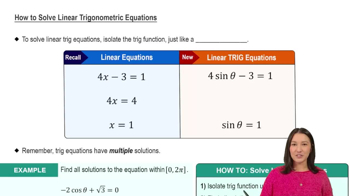
Solving trigonometric equations involves using known values of sine and cosine for special angles or applying identities to find exact solutions. Understanding the domain and range of inverse functions is essential to determine all valid solutions.
Recommended video:
4:34
How to Solve Linear Trigonometric Equations