Ch. 1 - Trigonometric Functions
Lial - Trigonometry 12th Edition
Lial12th EditionTrigonometryISBN: 9780136552161Not the one you use?Change textbook
Chapter 2, Problem 128

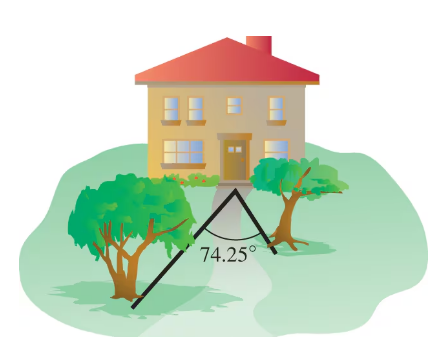
Solve each problem. See Example 6. Surveying One student in a surveying class measures an angle as 74.25°, while another student measures the same angle as 74° 20' . Find the difference between these measurements, both to the nearest minute and to the nearest hundredth of a degree.
Diagram of a house with two trees and an angle of 74.25 degrees formed between lines from the trees to the house.

Verified step by step guidance
1
First, convert both angle measurements into a consistent format. The first measurement is already in decimal degrees: 74.25°.
Convert the second measurement, 74° 20', into decimal degrees. Recall that 1 minute (') equals \( \frac{1}{60} \) degrees, so calculate the decimal equivalent of 20 minutes as \( 20 \times \frac{1}{60} \).
Add the decimal equivalent of the minutes to the degrees in the second measurement to get the full decimal degree value.
Find the difference between the two decimal degree values by subtracting the smaller from the larger.
To express the difference to the nearest minute, convert the decimal difference back into degrees and minutes by multiplying the decimal part by 60, then round to the nearest whole minute.

Verified video answer for a similar problem:

This video solution was recommended by our tutors as helpful for the problem above.
Video duration:
4m
Was this helpful?

Key Concepts

Here are the essential concepts you must grasp in order to answer the question correctly.

Angle Measurement Units

Angles can be measured in degrees, minutes, and seconds, where 1 degree equals 60 minutes and 1 minute equals 60 seconds. Understanding how to convert between decimal degrees and degrees-minutes-seconds (DMS) is essential for comparing and calculating differences in angle measurements.
Recommended video:
5:31
Reference Angles on the Unit Circle

Conversion Between Decimal Degrees and DMS

To convert decimal degrees to degrees and minutes, separate the integer part as degrees and multiply the decimal part by 60 to get minutes. Conversely, to convert from degrees and minutes to decimal degrees, divide the minutes by 60 and add to the degrees. This conversion allows for accurate comparison and calculation.
Recommended video:
5:04
Converting between Degrees & Radians

Rounding and Precision in Angle Measurements

Rounding angle measurements to the nearest minute or hundredth of a degree requires understanding place value and precision. Proper rounding ensures that the difference between measurements is expressed accurately and meaningfully, which is important in fields like surveying where precision matters.
Recommended video:
5:31
Reference Angles on the Unit Circle