
Textbook Question
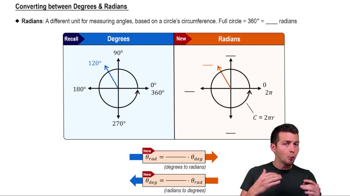
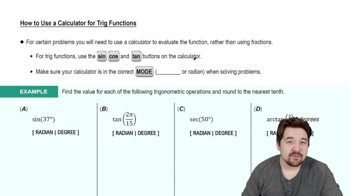
Convert each angle measure to degrees, minutes, and seconds. If applicable, round to the nearest second. -25.485°
707
views

 Verified step by step guidance
 5:04
5:04
 4:45
4:45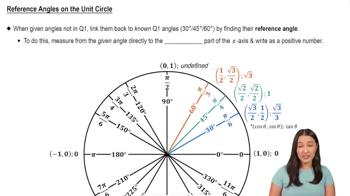 5:31
5:31Convert each angle measure to degrees, minutes, and seconds. If applicable, round to the nearest second. -25.485°
Use identities to solve each of the following. Rationalize denominators when applicable. See Examples 5–7. Find csc θ , given that cot θ = ―1/2 and θ is in quadrant IV.
In each figure, there are two similar triangles. Find the unknown measurement. Give approximations to the nearest tenth.
Find the indicated function value. If it is undefined, say so. See Example 4. sin(―270°)
Solve each problem. Solar Eclipse on Earth The sun has a diameter of about 865,000 mi with a maximum distance from Earth's surface of about 94,500,000 mi. The moon has a smaller diameter of 2159 mi. For a total solar eclipse to occur, the moon must pass between Earth and the sun. The moon must also be close enough to Earth for the moon's umbra (shadow) to reach the surface of Earth. (Data from Karttunen, H., P. Kröger, H. Oja, M. Putannen, and K. Donners, Editors, Fundamental Astronomy, Fourth Edition, Springer-Verlag.) a. Calculate the maximum distance, to the nearest thousand miles, that the moon can be from Earth and still have a total solar eclipse occur. (Hint: Use similar triangles.)
Find the indicated function value. If it is undefined, say so. See Example 4. sec 180°