Ch. 1 - Angles and the Trigonometric Functions
Blitzer - Trigonometry 3rd Edition
Blitzer3rd EditionTrigonometryISBN: 9780137316601Not the one you use?Change textbook
Chapter 1, Problem 31

In Exercises 31–38, find a cofunction with the same value as the given expression. sin 7°

Verified step by step guidance
1
Recall the cofunction identity for sine and cosine: \(\sin(\theta) = \cos(90^\circ - \theta)\).
Identify the angle in the given expression: here, \(\theta = 7^\circ\).
Apply the cofunction identity by substituting \(\theta\) with \(7^\circ\) to find the equivalent cosine expression.
Write the cofunction expression as \(\cos(90^\circ - 7^\circ)\).
Simplify the angle inside the cosine function to get \(\cos(83^\circ)\), which is the cofunction with the same value as \(\sin 7^\circ\).

Verified video answer for a similar problem:

This video solution was recommended by our tutors as helpful for the problem above.
Video duration:
1m
Was this helpful?

Key Concepts

Here are the essential concepts you must grasp in order to answer the question correctly.

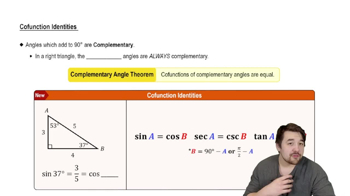
Cofunction Identity

Cofunction identities relate the trigonometric functions of complementary angles, meaning angles that add up to 90°. For sine and cosine, the identity is sin(θ) = cos(90° - θ). This allows us to express sine values in terms of cosine and vice versa.
Recommended video:
6:30
Cofunction Identities

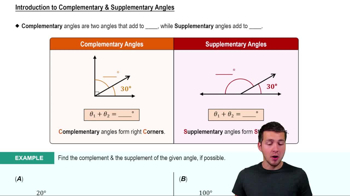
Complementary Angles

Complementary angles are two angles whose measures add up to 90°. Understanding this concept is essential because cofunction identities rely on the relationship between an angle and its complement to find equivalent trigonometric values.
Recommended video:
3:35
Intro to Complementary & Supplementary Angles

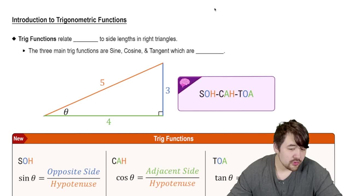
Trigonometric Function Values

Knowing how to evaluate or manipulate trigonometric functions like sine and cosine is crucial. Recognizing that sin 7° can be rewritten using a cofunction identity helps simplify expressions or solve equations involving trigonometric values.
Recommended video:
6:04
Introduction to Trigonometric Functions
Related Practice
Textbook Question

In Exercises 25–32, the unit circle has been divided into eight equal arcs, corresponding to t-values of


0, 𝜋/4, 𝜋/2, 3𝜋/4, 𝜋, 5𝜋/4, 3𝜋/2, 7𝜋/4, and 2𝜋.


a. Use the (x,y) coordinates in the figure to find the value of the trigonometric function.

b. Use periodic properties and your answer from part (a) to find the value of the same trigonometric function at the indicated real number.

cot 15𝜋/2

1104
views
Textbook Question

In Exercises 23–34, find the exact value of each of the remaining trigonometric functions of θ. tan θ = 4/3, cos θ < 0

593
views
Textbook Question

In Exercises 25–32, the unit circle has been divided into eight equal arcs, corresponding to t-values of


0, 𝜋/4, 𝜋/2, 3𝜋/4, 𝜋, 5𝜋/4, 3𝜋/2, 7𝜋/4, and 2𝜋.


a. Use the (x,y) coordinates in the figure to find the value of the trigonometric function.

b. Use periodic properties and your answer from part (a) to find the value of the same trigonometric function at the indicated real number.

<IMAGE>


cot 𝜋/2

460
views
Textbook Question

In Exercises 30–32, find the measure of the side of the right triangle whose length is designated by a lowercase letter. Round answers to the nearest whole number.

484
views
Textbook Question

Find a cofunction with the same value as the given expression.

sin 19°

616
views
Textbook Question

In Exercises 25–32, the unit circle has been divided into eight equal arcs, corresponding to t-values of

0, 𝜋/4, 𝜋/2, 3𝜋/4, 𝜋, 5𝜋/4, 3𝜋/2, 7𝜋/4, and 2𝜋.

a. Use the (x,y) coordinates in the figure to find the value of the trigonometric function.

b. Use periodic properties and your answer from part (a) to find the value of the same trigonometric function at the indicated real number.

<Image>

sin 47𝜋/4

890
views