Identify the property illustrated in each statement. Assume all variables represent real numbers. (t - 6) • ( 1/(t-6)) = 1, if t - 6 ≠ 0
Table of contents
- 0. Review of College Algebra4h 45m
- 1. Measuring Angles40m
- 2. Trigonometric Functions on Right Triangles2h 5m
- 3. Unit Circle1h 19m
- 4. Graphing Trigonometric Functions1h 19m
- 5. Inverse Trigonometric Functions and Basic Trigonometric Equations1h 41m
- 6. Trigonometric Identities and More Equations2h 34m
- 7. Non-Right Triangles1h 38m
- 8. Vectors2h 25m
- 9. Polar Equations2h 5m
- 10. Parametric Equations1h 6m
- 11. Graphing Complex Numbers1h 7m
0. Review of College Algebra
Solving Linear Equations
Problem R.2.115
Textbook Question
Identify the property illustrated in each statement. Assume all variables represent real numbers. 5 + √3 is a real number.
Verified step by step guidance1
Recognize that the problem asks to identify the property illustrated by the expression \(5 + \sqrt{3}\), where all variables represent real numbers.
Recall that the set of real numbers is closed under addition, meaning that the sum of any two real numbers is also a real number.
Note that \$5$ is a real number and \(\sqrt{3}\) is also a real number because the square root of a positive real number is real.
Apply the closure property of addition: since both \$5$ and \(\sqrt{3}\) are real numbers, their sum \(5 + \sqrt{3}\) must also be a real number.
Conclude that the property illustrated here is the Closure Property of Addition for real numbers.
Verified video answer for a similar problem:This video solution was recommended by our tutors as helpful for the problem above
Video duration:
2mPlay a video:
0 Comments
Key Concepts
Here are the essential concepts you must grasp in order to answer the question correctly.
Real Numbers
Real numbers include all rational and irrational numbers that can be found on the number line. They encompass integers, fractions, and roots like √3, representing quantities with magnitude but no imaginary component.
Recommended video:
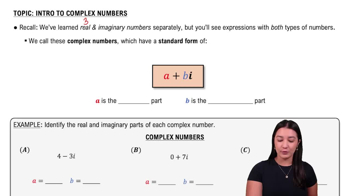
Introduction to Complex Numbers
Properties of Real Numbers
Real numbers are closed under addition, meaning the sum of any two real numbers is also a real number. This property ensures expressions like 5 + √3 remain within the set of real numbers.
Recommended video:
Introduction to Complex Numbers
Irrational Numbers
Irrational numbers cannot be expressed as a simple fraction and have non-repeating, non-terminating decimal expansions. √3 is an example, and when added to a rational number like 5, the result is still a real number.
Recommended video:
Introduction to Complex Numbers
Related Videos
Related Practice
Textbook Question
529
views