Start by isolating the arctan function. Multiply both sides of the equation by \( \frac{3}{4} \) to get \( \arctan\left(\frac{x}{2}\right) = \frac{3\pi}{4} \).
Recall that the arctan function, or inverse tangent, gives the angle whose tangent is the given number. So, we need to find the angle \( \theta \) such that \( \tan(\theta) = \frac{x}{2} \) and \( \theta = \frac{3\pi}{4} \).
Recognize that \( \tan\left(\frac{3\pi}{4}\right) \) is a known value. Use the unit circle or trigonometric identities to find \( \tan\left(\frac{3\pi}{4}\right) \).
Set \( \frac{x}{2} = \tan\left(\frac{3\pi}{4}\right) \) and solve for \( x \) by multiplying both sides by 2.
Simplify the expression to find the value of \( x \).
Verified video answer for a similar problem:
This video solution was recommended by our tutors as helpful for the problem above
Play a video:
0 Comments
Key Concepts
Here are the essential concepts you must grasp in order to answer the question correctly.
Inverse Trigonometric Functions
Inverse trigonometric functions, such as arctan, are used to find angles when given a ratio of sides in a right triangle. For example, if y = arctan(x), then tan(y) = x. Understanding how to manipulate these functions is crucial for solving equations involving them, as they allow us to isolate the variable representing the angle.
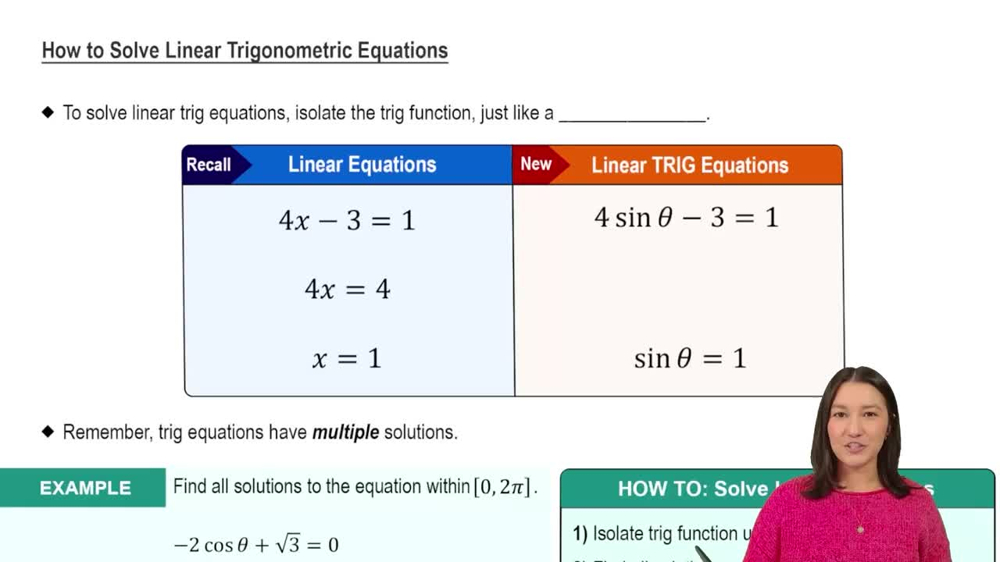
Solving trigonometric equations involves finding the values of the variable that satisfy the equation. This often requires using algebraic techniques to isolate the trigonometric function and then applying inverse functions to find the angle. In this case, we need to manipulate the equation to express x in terms of known values.
In trigonometry, π (pi) represents a fundamental constant, approximately equal to 3.14, and is crucial in defining the relationship between angles and their corresponding trigonometric values. When solving equations involving π, it is important to recognize its role in determining angle measures, particularly in radians, which is the standard unit for measuring angles in trigonometric functions.

 Verified step by step guidance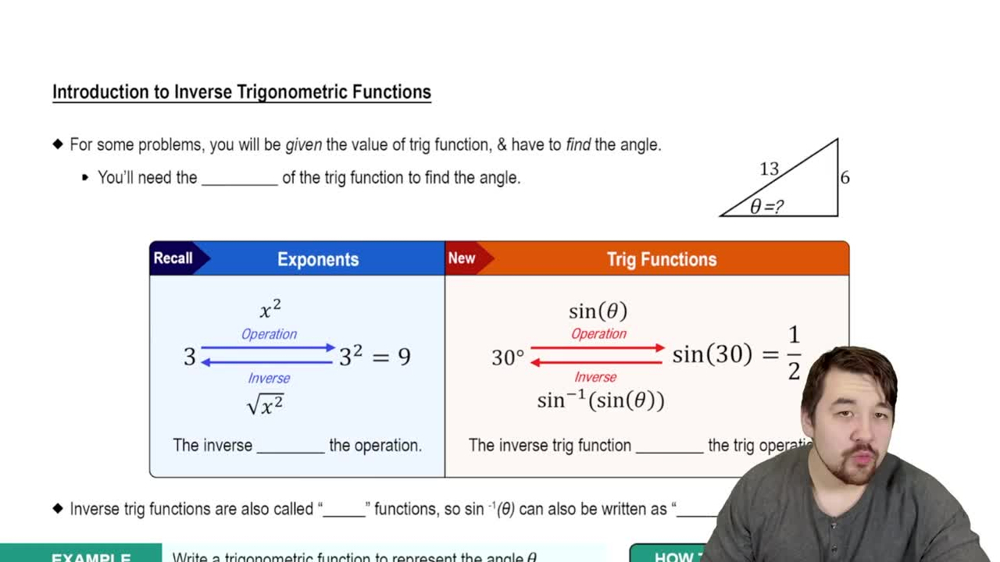
 4:28
4:28