Ch. R - Algebra Review
Lial - Trigonometry 12th Edition
Lial12th EditionTrigonometryISBN: 9780136552161Not the one you use?Change textbook
Chapter 1, Problem 1

Fill in the blank(s) to correctly complete each sentence.
To graph the function ƒ(x) = x² - 3, shift the graph of y = x² down ___ units.

Verified step by step guidance
1
Identify the base function and the transformation applied. The base function here is \(y = x^{2}\), which is a standard parabola centered at the origin.
Recognize that the function \(ƒ(x) = x^{2} - 3\) is a vertical shift of the base function \(y = x^{2}\).
Understand that subtracting a constant from the function, as in \(x^{2} - 3\), shifts the graph vertically downward by that constant value.
Therefore, the graph of \(ƒ(x) = x^{2} - 3\) is the graph of \(y = x^{2}\) shifted down by 3 units.
Fill in the blank with the number 3, indicating the downward shift in units.

Verified video answer for a similar problem:

This video solution was recommended by our tutors as helpful for the problem above.
Video duration:
1m
Was this helpful?

Key Concepts

Here are the essential concepts you must grasp in order to answer the question correctly.

Graphing Quadratic Functions

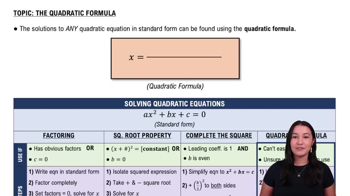
Graphing quadratic functions involves plotting parabolas based on the equation y = ax² + bx + c. The basic shape is determined by the coefficient a, while the position is influenced by b and c. Understanding how changes in the equation affect the graph is essential for accurate plotting.
Recommended video:
6:36
Quadratic Formula

Vertical Shifts of Graphs

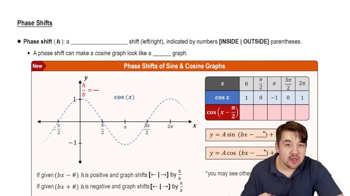
A vertical shift moves the entire graph up or down without changing its shape. Adding or subtracting a constant k to the function, as in y = f(x) + k, shifts the graph vertically by k units. Positive k shifts the graph up, while negative k shifts it down.
Recommended video:
6:31
Phase Shifts

Interpreting Function Transformations

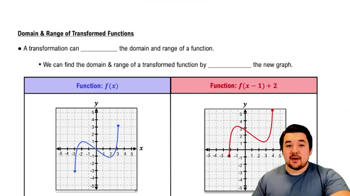
Function transformations describe how changes to the equation affect the graph's position and shape. Recognizing these transformations, such as shifts, stretches, and reflections, helps in quickly sketching or understanding the graph of modified functions.
Recommended video:
4:22
Domain and Range of Function Transformations