Evaluate each expression for p = -4, q = 8, and r = -10. See Example 6. (-(p + 2)² - 3r)/(2 - q)
Table of contents
- 0. Review of College Algebra4h 45m
- 1. Measuring Angles40m
- 2. Trigonometric Functions on Right Triangles2h 5m
- 3. Unit Circle1h 19m
- 4. Graphing Trigonometric Functions1h 19m
- 5. Inverse Trigonometric Functions and Basic Trigonometric Equations1h 41m
- 6. Trigonometric Identities and More Equations2h 34m
- 7. Non-Right Triangles1h 38m
- 8. Vectors2h 25m
- 9. Polar Equations2h 5m
- 10. Parametric Equations1h 6m
- 11. Graphing Complex Numbers1h 7m
0. Review of College Algebra
Solving Linear Equations
Problem R.2.111
Textbook Question
Identify the property illustrated in each statement. Assume all variables represent real numbers. 5(t + 3) = (t + 3) • 5
Verified step by step guidance1
Recognize that the equation given is \(5(t + 3) = (t + 3) \cdot 5\), which shows two expressions multiplied in different orders.
Recall the Commutative Property of Multiplication, which states that for any real numbers \(a\) and \(b\), \(a \times b = b \times a\).
Identify that in this problem, \(a = 5\) and \(b = (t + 3)\), so switching their order does not change the product.
Understand that this property allows us to rearrange factors in a multiplication without affecting the result.
Conclude that the property illustrated by the equation is the Commutative Property of Multiplication.
Verified video answer for a similar problem:This video solution was recommended by our tutors as helpful for the problem above
Video duration:
1mPlay a video:
0 Comments
Key Concepts
Here are the essential concepts you must grasp in order to answer the question correctly.
Commutative Property of Multiplication
This property states that changing the order of factors does not change the product. For any real numbers a and b, a × b = b × a. In the given equation, 5(t + 3) = (t + 3) × 5, the factors 5 and (t + 3) are swapped, illustrating this property.
Recommended video:
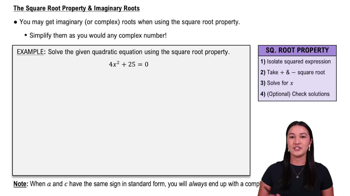
Imaginary Roots with the Square Root Property
Multiplication of a Number and an Expression
Multiplying a number by an algebraic expression involves distributing the multiplication over the entire expression or treating the expression as a single factor. Here, 5 is multiplied by the entire quantity (t + 3), emphasizing that the expression acts as one factor in multiplication.
Recommended video:
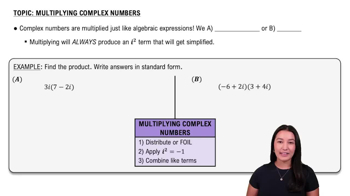
Multiplying Complex Numbers
Real Numbers and Variables
Variables represent real numbers in algebraic expressions, allowing generalization of properties. Understanding that t is a real number ensures that multiplication and properties like commutativity apply, making the equation valid for all real values of t.
Recommended video:
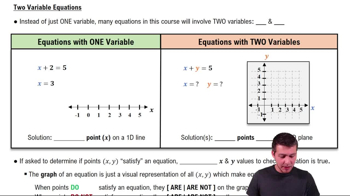
Equations with Two Variables
Related Videos
Related Practice
Textbook Question
490
views