Evaluate each expression without using a calculator. sec (sec⁻¹ 2)
Verified step by step guidance
1
Recognize that the expression is \( \sec(\sec^{-1} 2) \). Here, \( \sec^{-1} 2 \) is the inverse secant function, which gives an angle \( \theta \) such that \( \sec \theta = 2 \).
Let \( \theta = \sec^{-1} 2 \). By definition, this means \( \sec \theta = 2 \).
The original expression \( \sec(\sec^{-1} 2) \) can be rewritten as \( \sec(\theta) \). Since \( \theta \) was chosen so that \( \sec \theta = 2 \), substitute this value back.
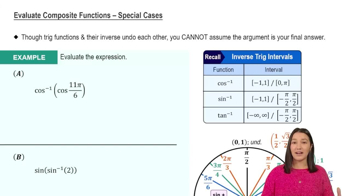
This shows that applying \( \sec \) to its inverse function \( \sec^{-1} \) returns the original input value, as long as it is within the domain of the inverse function.
Verified video answer for a similar problem:
This video solution was recommended by our tutors as helpful for the problem above
Play a video:
0 Comments
Key Concepts
Here are the essential concepts you must grasp in order to answer the question correctly.
Inverse Trigonometric Functions
Inverse trigonometric functions, like sec⁻¹(x), return the angle whose trigonometric function equals x. For sec⁻¹ 2, it means finding the angle θ such that sec(θ) = 2. Understanding the domain and range of these inverse functions is essential for correct evaluation.
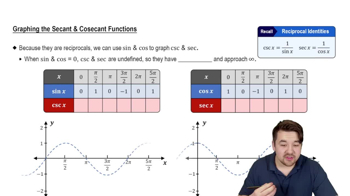
The secant function is the reciprocal of the cosine function, defined as sec(θ) = 1/cos(θ). Knowing this relationship helps in simplifying expressions and understanding how sec and its inverse interact, especially when evaluating compositions like sec(sec⁻¹ x).
When a function is composed with its inverse, such as sec(sec⁻¹ x), the result is typically x within the domain of the inverse function. Recognizing this property allows for direct simplification without calculation, provided the input lies within the valid range.

 Verified step by step guidance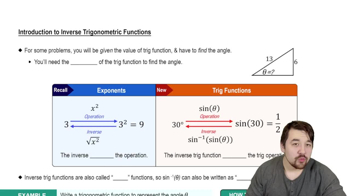
 4:28
4:28