Express each function as a trigonometric function of x. See Example 5.
cos 4x
Verified step by step guidance
1
Recognize that the problem asks to express \( \cos 4x \) as a trigonometric function of \( x \), which typically involves using multiple-angle formulas or power-reduction formulas.
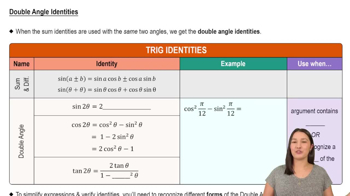
Recall the double-angle formula for cosine: \( \cos 2\theta = 2\cos^2 \theta - 1 \). This formula can be applied repeatedly to express \( \cos 4x \) in terms of \( \cos x \).
First, express \( \cos 4x \) as \( \cos(2 \cdot 2x) \) and apply the double-angle formula: \( \cos 4x = 2\cos^2 2x - 1 \).
Next, express \( \cos 2x \) in terms of \( \cos x \) using the double-angle formula again: \( \cos 2x = 2\cos^2 x - 1 \). Substitute this into the previous expression.
Combine the expressions to write \( \cos 4x \) fully in terms of \( \cos x \), resulting in a polynomial expression involving powers of \( \cos x \).
Verified video answer for a similar problem:

This video solution was recommended by our tutors as helpful for the problem above
Play a video:
0 Comments
Key Concepts
Here are the essential concepts you must grasp in order to answer the question correctly.
Multiple-Angle Trigonometric Functions
Multiple-angle functions involve trigonometric expressions where the angle is multiplied by an integer, such as cos(4x). Understanding how to express these in terms of single angles or simpler functions is essential for simplification and solving equations.
Double-angle formulas, like cos(2x) = 2cos²x - 1, help break down functions of multiple angles into expressions involving single angles. Power-reduction formulas further simplify powers of sine and cosine, aiding in expressing cos(4x) in terms of cos x.
Trigonometric Identities and Algebraic Manipulation
Using fundamental identities and algebraic techniques allows rewriting complex trigonometric functions into simpler forms. Mastery of identities like cos(A+B) and cos(2x) is crucial for expressing cos(4x) as a function of x.