Ch. 5 - Trigonometric Identities
Lial - Trigonometry 12th Edition
Lial12th EditionTrigonometryISBN: 9780136552161Not the one you use?Change textbook
Chapter 6, Problem 5.RE.2

For each expression in Column I, choose the expression from Column II that completes an identity.
2. csc x = ____


II
A. sin ^2 x/cos ^2 x
B.1/(sec ^2 x)
C. sin (-x)
D. csc ^2 x-cot ^2 x + sin ^2 x
E. tan x

Verified step by step guidance
1
Recall the definition of the cosecant function in terms of sine: \(\csc x = \frac{1}{\sin x}\).
Identify the expression in Column II that matches \(\frac{1}{\sin x}\) or is equivalent to it.
Verify that the chosen expression satisfies the identity by considering the domain where \(\sin x \neq 0\) to avoid division by zero.
Understand that this identity is fundamental because cosecant is the reciprocal of sine, which is a key concept in trigonometry.
Confirm that the expression from Column II correctly completes the identity \(\csc x = \frac{1}{\sin x}\).

Verified video answer for a similar problem:

This video solution was recommended by our tutors as helpful for the problem above.
Was this helpful?

Key Concepts

Here are the essential concepts you must grasp in order to answer the question correctly.

Reciprocal Trigonometric Functions

The cosecant function (csc x) is the reciprocal of the sine function. This means csc x = 1/sin x, which is fundamental for rewriting or completing trigonometric identities involving csc x.
Recommended video:
6:04
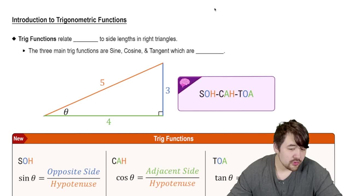
Introduction to Trigonometric Functions

Trigonometric Identities

Trigonometric identities are equations involving trigonometric functions that hold true for all values within their domains. Recognizing and applying these identities helps simplify expressions and solve equations.
Recommended video:
5:32
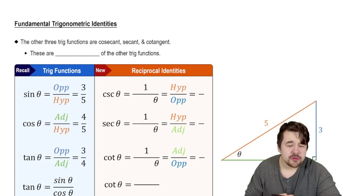
Fundamental Trigonometric Identities

Domain and Range of Trigonometric Functions

Understanding the domain and range of functions like sine and cosecant is important because csc x is undefined where sin x = 0. This knowledge ensures correct application of identities and avoids division by zero.
Recommended video:
4:22
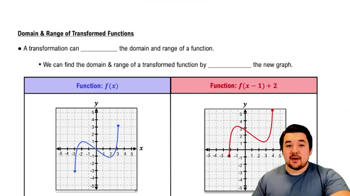
Domain and Range of Function Transformations