Ch. 5 - Complex Numbers, Polar Coordinates and Parametric Equations
Blitzer - Trigonometry 3rd Edition
Blitzer3rd EditionTrigonometryISBN: 9780137316601Not the one you use?Change textbook
Chapter 5, Problem 5.1.47

In Exercises 37–52, perform the indicated operations and write the result in standard form.
( −6 − √(−12)) / 48

Verified step by step guidance
1
Identify the expression to simplify: \(\frac{-5 - \sqrt{-12}}{48}\). Notice that \(\sqrt{-12}\) involves an imaginary number because of the negative under the square root.
Rewrite the square root of the negative number using the imaginary unit \(i\), where \(i = \sqrt{-1}\). So, \(\sqrt{-12} = \sqrt{12} \times i\).
Simplify \(\sqrt{12}\) by factoring it into \(\sqrt{4 \times 3} = \sqrt{4} \times \sqrt{3} = 2\sqrt{3}\). Therefore, \(\sqrt{-12} = 2\sqrt{3}i\).
Substitute back into the original expression: \(\frac{-5 - 2\sqrt{3}i}{48}\). Now, separate the real and imaginary parts by dividing both terms in the numerator by 48.
Write the expression in standard form \(a + bi\) as \(\frac{-5}{48} - \frac{2\sqrt{3}}{48}i\). Simplify the fractions if possible to complete the standard form.

Verified video answer for a similar problem:

This video solution was recommended by our tutors as helpful for the problem above.
Video duration:
4m
Was this helpful?

Key Concepts

Here are the essential concepts you must grasp in order to answer the question correctly.

Complex Numbers and Standard Form

Complex numbers are expressed in the form a + bi, where a is the real part and b is the imaginary part. The standard form requires separating real and imaginary components clearly, which is essential when simplifying expressions involving square roots of negative numbers.
Recommended video:
04:47
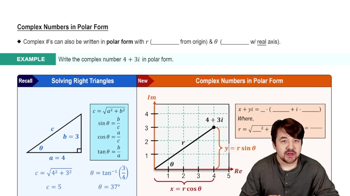
Complex Numbers In Polar Form

Simplifying Square Roots of Negative Numbers

The square root of a negative number involves imaginary units, where √(-x) = i√x. Recognizing and converting these roots into terms involving i is crucial for handling expressions like √(-12), enabling further algebraic manipulation.
Recommended video:
2:20
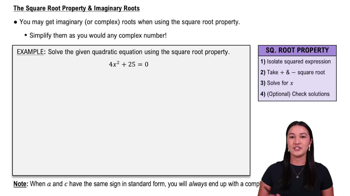
Imaginary Roots with the Square Root Property

Operations with Complex Numbers

Performing addition, subtraction, multiplication, or division with complex numbers requires combining like terms and applying algebraic rules, including distributing and rationalizing denominators. Mastery of these operations ensures the expression can be simplified correctly into standard form.
Recommended video:
4:22
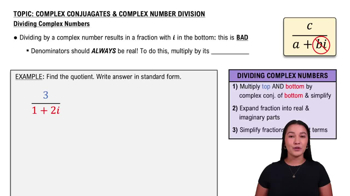
Dividing Complex Numbers