Ch. 5 - Complex Numbers, Polar Coordinates and Parametric Equations
Blitzer - Trigonometry 3rd Edition
Blitzer3rd EditionTrigonometryISBN: 9780137316601Not the one you use?Change textbook
Chapter 5, Problem 31

In Exercises 27–36, write each complex number in rectangular form. If necessary, round to the nearest tenth. 8(cos 7π/4 + i sin 7π/4)

Verified step by step guidance
1
Recognize that the given complex number is in polar (trigonometric) form: \(r(\cos \theta + i \sin \theta)\), where \(r = 8\) and \(\theta = \frac{7\pi}{4}\).
Recall that to convert from polar form to rectangular form, use the formulas: \(x = r \cos \theta\) and \(y = r \sin \theta\), where \(x\) is the real part and \(y\) is the imaginary part.
Calculate the real part: \(x = 8 \times \cos \left( \frac{7\pi}{4} \right)\).
Calculate the imaginary part: \(y = 8 \times \sin \left( \frac{7\pi}{4} \right)\).
Write the rectangular form as \(x + yi\), substituting the values found for \(x\) and \(y\). If necessary, round the values to the nearest tenth.

Verified video answer for a similar problem:

This video solution was recommended by our tutors as helpful for the problem above.
Video duration:
4m
Was this helpful?

Key Concepts

Here are the essential concepts you must grasp in order to answer the question correctly.

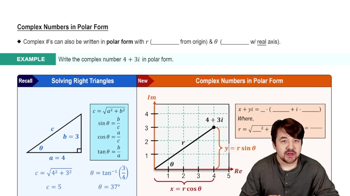
Polar Form of Complex Numbers

A complex number can be expressed in polar form as r(cos θ + i sin θ), where r is the magnitude (distance from the origin) and θ is the argument (angle with the positive real axis). This form is useful for multiplication, division, and finding powers or roots of complex numbers.
Recommended video:
04:47
Complex Numbers In Polar Form

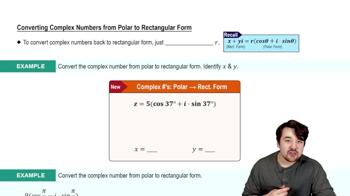
Conversion from Polar to Rectangular Form

To convert a complex number from polar to rectangular form, use the formulas x = r cos θ and y = r sin θ, where x is the real part and y is the imaginary part. The rectangular form is written as x + iy, which is often easier to interpret and use in algebraic operations.
Recommended video:
03:58
Converting Complex Numbers from Polar to Rectangular Form

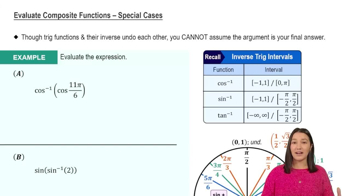
Evaluating Trigonometric Functions at Specific Angles

Understanding the values of cosine and sine at common angles, such as 7π/4, is essential. For 7π/4 (or 315°), cos(7π/4) = √2/2 and sin(7π/4) = -√2/2. These values help accurately convert the complex number into its rectangular form.
Recommended video:
3:48
Evaluate Composite Functions - Special Cases