Ch. 1 - Trigonometric Functions
Lial - Trigonometry 12th Edition
Lial12th EditionTrigonometryISBN: 9780136552161Not the one you use?Change textbook
Chapter 2, Problem 105

Write an expression that generates all angles coterminal with each angle. Let n represent any integer. ―90°

Verified step by step guidance
1
Understand that coterminal angles are angles that differ by full rotations. Since one full rotation is 360°, coterminal angles can be found by adding or subtracting multiples of 360°.
Let the given angle be \(-90^\circ\). To find all angles coterminal with \(-90^\circ\), add \(360^\circ\) multiplied by any integer \(n\) to the angle.
Write the general expression for coterminal angles as: \(-90^\circ + 360^\circ \times n\) where \(n\) is any integer (\(n \in \mathbb{Z}\)).
This expression generates all angles that share the same terminal side as \(-90^\circ\) when drawn in standard position.
Remember that \(n\) can be positive, negative, or zero, which accounts for rotations in both directions and the original angle itself.

Verified video answer for a similar problem:
This video solution was recommended by our tutors as helpful for the problem above.
Video duration:
2m
Was this helpful?

Key Concepts

Here are the essential concepts you must grasp in order to answer the question correctly.

Coterminal Angles

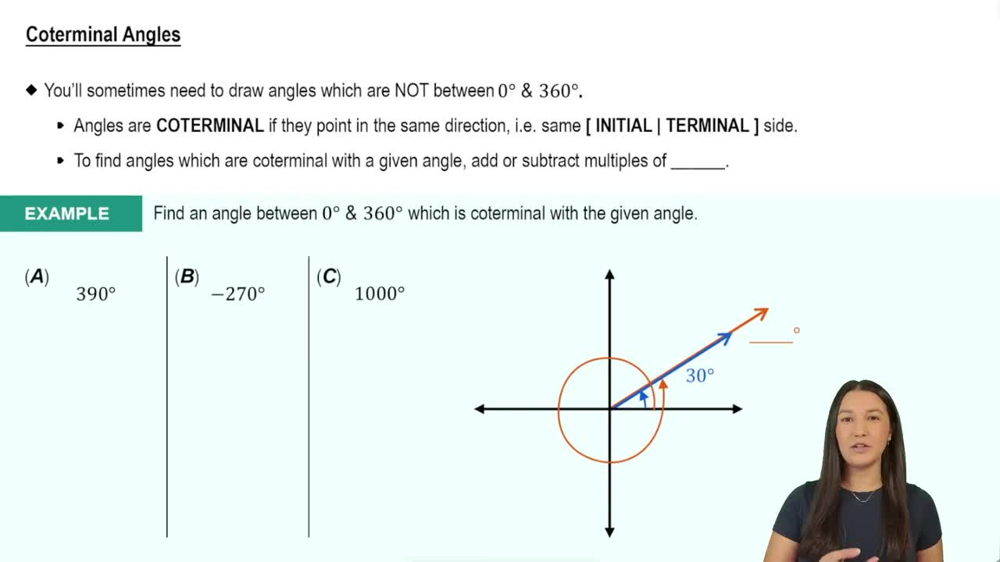
Coterminal angles are angles that share the same initial and terminal sides but differ by full rotations. They can be found by adding or subtracting multiples of 360° (for degrees) or 2π (for radians) to the given angle.
Recommended video:
04:46
Coterminal Angles

General Formula for Coterminal Angles

The general expression for all angles coterminal with a given angle θ is θ + 360°·n, where n is any integer. This formula accounts for all possible rotations around the circle, both clockwise and counterclockwise.
Recommended video:
04:46
Coterminal Angles

Integer Parameter n

The variable n represents any integer (positive, negative, or zero) and indicates the number of full rotations added or subtracted. This allows the formula to generate infinitely many coterminal angles by varying n.
Recommended video:
05:59
Eliminating the Parameter