Ch. R - Algebra Review
Lial - Trigonometry 12th Edition
Lial12th EditionTrigonometryISBN: 9780136552161Not the one you use?Change textbook
Chapter 1, Problem R.2.149

Simplify each expression. See Example 8. 0.25(8 + 4p) - 0.5(6 + 2p)

Verified step by step guidance
1
First, distribute the constants 0.25 and 0.5 to each term inside their respective parentheses. This means multiplying 0.25 by both 8 and 4p, and 0.5 by both 6 and 2p. Write this as: \(0.25 \times 8 + 0.25 \times 4p - (0.5 \times 6 + 0.5 \times 2p)\).
Next, perform the multiplications for each term: calculate \(0.25 \times 8\), \(0.25 \times 4p\), \(0.5 \times 6\), and \(0.5 \times 2p\) separately.
After multiplying, rewrite the expression with the new terms, keeping track of the subtraction sign before the second group of terms: \(\text{(result of first group)} - \text{(result of second group)}\).
Now, remove the parentheses by distributing the subtraction sign across the second group of terms, changing the signs of each term inside the parentheses accordingly.
Finally, combine like terms by adding or subtracting the coefficients of the constant terms and the terms with the variable \(p\) to simplify the expression as much as possible.

Verified video answer for a similar problem:

This video solution was recommended by our tutors as helpful for the problem above.
Video duration:
3m
Was this helpful?

Key Concepts

Here are the essential concepts you must grasp in order to answer the question correctly.

Distributive Property

The distributive property allows you to multiply a single term by each term inside a parenthesis. For example, a(b + c) = ab + ac. This property is essential for simplifying expressions like 0.25(8 + 4p) by distributing 0.25 to both 8 and 4p.
Recommended video:
2:20
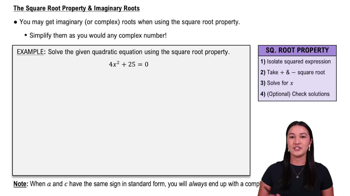
Imaginary Roots with the Square Root Property

Combining Like Terms

Combining like terms involves adding or subtracting terms that have the same variable raised to the same power. After distributing, terms with 'p' and constant terms should be grouped and simplified to reduce the expression to its simplest form.
Recommended video:
3:18
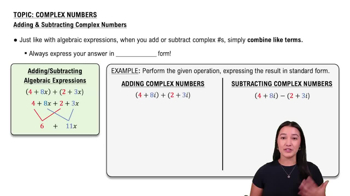
Adding and Subtracting Complex Numbers

Basic Arithmetic with Decimals

Understanding how to multiply and subtract decimals is crucial for simplifying expressions involving decimal coefficients. Accurate decimal operations ensure the correct simplification of terms like 0.25 × 8 and 0.5 × 6.
Recommended video:
4:08
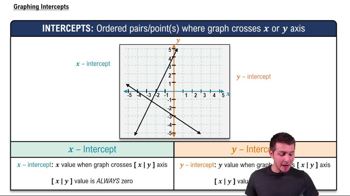
Graphing Intercepts