
(Modeling) Speed of Light When a light ray travels from one medium, such as air, to another medium, such as water or glass, the speed of the light changes, and the light ray is bent, or refracted, at the boundary between the two media. (This is why objects under water appear to be in a different position from where they really are.) It can be shown in physics that these changes are related by Snell's law c₁ = sin θ₁ , c₂ sin θ₂ where c₁ is the speed of light in the first medium, c₂ is the speed of light in the second medium, and θ₁ and θ₂ are the angles shown in the figure. In Exercises 81 and 82, assume that c₁ = 3 x 10⁸ m per sec. Find the speed of light in the second medium for each of the following. a. θ₁ = 46°, θ₂ = 31° b. θ₁ = 39°, θ₂ = 28°

- Ch. R - Algebra Review381
- Ch. 1 - Trigonometric Functions188
- Ch. 2 - Acute Angles and Right Triangles168
- Ch. 3 - Radian Measure and The Unit Circle155
- Ch. 4 - Graphs of the Circular Functions100
- Ch. 5 - Trigonometric Identities238
- Ch. 6 - Inverse Circular Functions and Trigonometric Equations158
- Ch. 7 - Applications of Trigonometry and Vectors148
- Ch. 8 - Complex Numbers, Polar Equations, and Parametric Equations15
Use a calculator to determine whether each statement is true or false. A true statement may lead to results that differ in the last decimal place due to rounding error. sin 10° + sin 10° = sin 20°
 Verified step by step guidance
Verified video answer for a similar problem:

Key Concepts
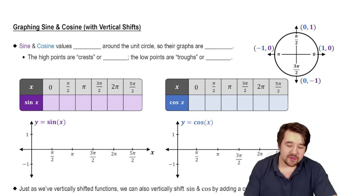
Sine Function and Angle Addition
 5:53
5:53
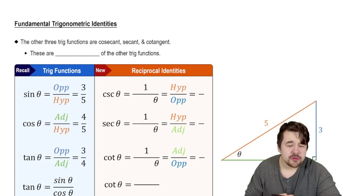
Trigonometric Identities
 5:32
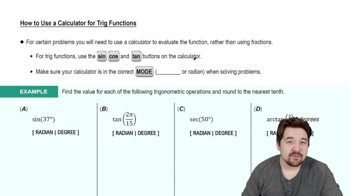
5:32Calculator Use and Rounding Errors
 4:45
4:45(Modeling) Grade Resistance Solve each problem. See Example 3. A 3000-lb car traveling uphill has a grade resistance of 150 lb. Find the angle of the grade to the nearest tenth of a degree.
(Modeling) Grade Resistance Solve each problem. See Example 3. A car traveling on a -3° downhill grade has a grade resistance of -145 lb. Determine the weight of the car to the nearest hundred pounds.
Use a calculator to approximate the value of each expression. Give answers to six decimal places. In Exercises 21–28, simplify the expression before using the calculator. See Example 1.
1/ sec 14.8°
Find two angles in the interval [0°, 360°) that satisfy each of the following. Round answers to the nearest degree. sin θ = 0.52991926
Use a calculator to approximate the value of each expression. Give answers to six decimal places. In Exercises 21–28, simplify the expression before using the calculator. See Example 1. csc 145° 45'