Ch. 1 - Angles and the Trigonometric Functions
Blitzer - Trigonometry 3rd Edition
Blitzer3rd EditionTrigonometryISBN: 9780137316601Not the one you use?Change textbook
Chapter 1, Problem 48

In Exercises 41–56, use the circle shown in the rectangular coordinate system to draw each angle in standard position. State the quadrant in which the angle lies. When an angle's measure is given in radians, work the exercise without converting to degrees.
Circle in rectangular coordinates for measuring angles in standard position.
-7πœ‹/4

Verified step by step guidance
1
Identify that the angle given is \(\frac{7\pi}{4}\) radians, which is in standard position, meaning it starts from the positive x-axis and rotates counterclockwise.
Recall that one full rotation around the circle is \(2\pi\) radians, so \(\frac{7\pi}{4}\) is less than \(2\pi\) but more than \(\frac{3\pi}{2}\), meaning the angle lies between \(270^\circ\) and \(360^\circ\) in degree terms, but we keep it in radians as instructed.
Note that \(\frac{7\pi}{4}\) radians corresponds to \(2\pi - \frac{\pi}{4}\), which means the angle is \(\frac{\pi}{4}\) radians less than a full rotation, placing it in the fourth quadrant.
To draw the angle, start at the positive x-axis (0 radians), then rotate counterclockwise around the circle until you reach \(\frac{7\pi}{4}\) radians, which is three-quarters of the way around plus an additional \(\frac{\pi}{4}\) radians.
Mark the terminal side of the angle on the circle in the fourth quadrant, between the positive x-axis and the negative y-axis, and state that the angle lies in the fourth quadrant.

Verified video answer for a similar problem:

This video solution was recommended by our tutors as helpful for the problem above.
Video duration:
2m
Was this helpful?

Key Concepts

Here are the essential concepts you must grasp in order to answer the question correctly.

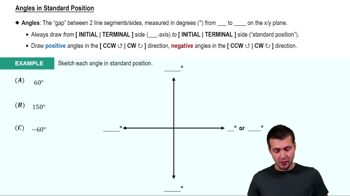
Angles in Standard Position

An angle is in standard position when its vertex is at the origin of the coordinate system and its initial side lies along the positive x-axis. The terminal side is determined by rotating the initial side counterclockwise for positive angles and clockwise for negative angles.
Recommended video:
05:50
Drawing Angles in Standard Position

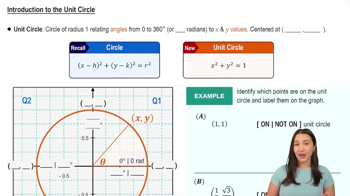
Radian Measure and the Unit Circle

Radian measure relates the length of an arc on the unit circle to the radius. One full rotation around the circle equals 2Ο€ radians. Angles can be expressed in radians without converting to degrees, which simplifies calculations involving the unit circle.
Recommended video:
06:11
Introduction to the Unit Circle

Quadrants of the Coordinate Plane

The coordinate plane is divided into four quadrants, numbered counterclockwise starting from the upper right. The quadrant in which the terminal side of an angle lies helps determine the sign of trigonometric functions and the angle's reference.
Recommended video:
6:36
Quadratic Formula