Find each exact function value. See Example 3. sin (-8π/ 3)
Verified step by step guidance
1
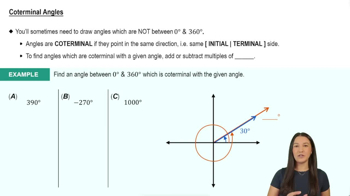
Recognize that the sine function is periodic with period \(2\pi\), meaning \(\sin(\theta) = \sin(\theta + 2k\pi)\) for any integer \(k\). This allows us to find an equivalent angle within the standard interval \([0, 2\pi)\) or \([-\pi, \pi)\) for easier evaluation.
Start with the given angle \(-\frac{8\pi}{3}\). To find a coterminal angle between \$0$ and \(2\pi\), add multiples of \(2\pi\) until the angle lies within this range. Specifically, add \(2\pi\) (which is \(\frac{6\pi}{3}\)) to \(-\frac{8\pi}{3}\):
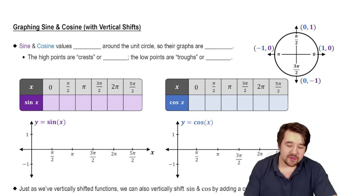
Now, evaluate \(\sin\left(\frac{4\pi}{3}\right)\). Recall that \(\frac{4\pi}{3}\) is in the third quadrant where sine is negative, and its reference angle is \(\pi - \frac{4\pi}{3} = \frac{\pi}{3}\). Use the known sine value for \(\frac{\pi}{3}\) to find the exact value.
Verified video answer for a similar problem:
This video solution was recommended by our tutors as helpful for the problem above
Play a video:
0 Comments
Key Concepts
Here are the essential concepts you must grasp in order to answer the question correctly.
Unit Circle and Angle Measurement in Radians
The unit circle is a circle with radius 1 centered at the origin, used to define trigonometric functions for all angles. Angles are often measured in radians, where 2π radians equal 360 degrees. Understanding how to locate angles on the unit circle, including negative and large angles, is essential for evaluating trigonometric functions like sine.
Angles that differ by full rotations (multiples of 2π) share the same terminal side and thus have the same trigonometric values. To find the exact value of functions like sin(-8π/3), reduce the angle by adding or subtracting 2π until it lies within the standard interval [0, 2π). This simplification helps in identifying the reference angle and corresponding function value.
The sine function gives the y-coordinate of a point on the unit circle corresponding to an angle. It is periodic with period 2π and odd, meaning sin(-θ) = -sin(θ). Knowing exact sine values for common angles (like π/3, π/6, π/4) allows precise evaluation without a calculator, which is crucial for finding exact values of sine at given angles.

 Verified step by step guidance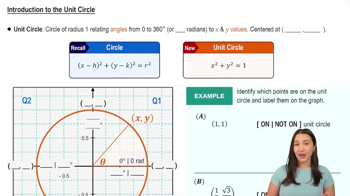
 06:11
06:11