In Exercises 17–32, two sides and an angle (SSA) of a triangle are given. Determine whether the given measurements produce one triangle, two triangles, or no triangle at all. Solve each triangle that results. Round to the nearest tenth and the nearest degree for sides and angles, respectively.a = 30, b = 20, A = 50°
Verified step by step guidance
1
Step 1: Use the Law of Sines to find angle B. The Law of Sines states that \( \frac{a}{\sin A} = \frac{b}{\sin B} \). Substitute the known values: \( \frac{30}{\sin 50^\circ} = \frac{20}{\sin B} \).
Step 2: Solve for \( \sin B \) by rearranging the equation: \( \sin B = \frac{20 \cdot \sin 50^\circ}{30} \).
Step 3: Determine the possible values for angle B. Since \( \sin B \) can have two possible angles (B and 180° - B) in the range of 0° to 180°, calculate both potential angles.
Step 4: Check if each potential angle B leads to a valid triangle by ensuring the sum of angles A, B, and C is 180°. If both angles are valid, there are two triangles; if only one is valid, there is one triangle; if neither is valid, there is no triangle.
Step 5: For each valid triangle, use the Law of Sines again to find the third side c. Use \( \frac{c}{\sin C} = \frac{a}{\sin A} \) to solve for c, where C is the remaining angle.
Verified video answer for a similar problem:
This video solution was recommended by our tutors as helpful for the problem above.
Video duration:
6m
Play a video:
0 Comments
Was this helpful?
Key Concepts
Here are the essential concepts you must grasp in order to answer the question correctly.
Law of Sines
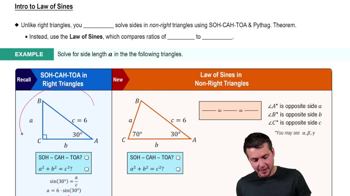
The Law of Sines relates the ratios of the lengths of sides of a triangle to the sines of its opposite angles. It is expressed as a/b = sin(A)/sin(B) = c/sin(C). This law is particularly useful in SSA (Side-Side-Angle) cases to determine unknown angles or sides, and it helps identify whether one, two, or no triangles can be formed based on the given measurements.
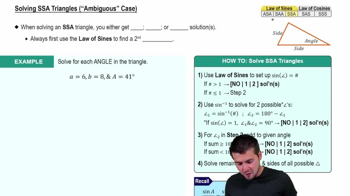
The SSA condition can lead to an ambiguous situation where two different triangles may be formed, one triangle may be formed, or no triangle may exist at all. This ambiguity arises because the given angle and two sides do not uniquely determine a triangle. Understanding how to analyze this case is crucial for solving problems involving SSA configurations.
The Triangle Sum Theorem states that the sum of the interior angles of a triangle is always 180 degrees. This theorem is essential when solving for unknown angles in a triangle, as it allows you to find missing angles once you have determined some angles using the Law of Sines or other methods. It ensures that the angles calculated are valid within the context of triangle geometry.


 Verified step by step guidance
 4:27
4:27