Ch. R - Algebra Review
Lial - Trigonometry 12th Edition
Lial12th EditionTrigonometryISBN: 9780136552161Not the one you use?Change textbook
Chapter 1, Problem 21

Concept Check Graph the points on a coordinate system and identify the quadrant or axis for each point. (3, 2)

Verified step by step guidance
1
Start by understanding the coordinate system: the horizontal axis is the x-axis and the vertical axis is the y-axis.
Locate the point (3, 2) by moving 3 units to the right along the x-axis because the x-coordinate is positive 3.
From that position, move 2 units up along the y-axis because the y-coordinate is positive 2.
Mark the point where these two movements intersect on the graph.
Identify the quadrant: since both x and y are positive, the point (3, 2) lies in Quadrant I.

Verified video answer for a similar problem:

This video solution was recommended by our tutors as helpful for the problem above.
Video duration:
1m
Was this helpful?

Key Concepts

Here are the essential concepts you must grasp in order to answer the question correctly.

Cartesian Coordinate System

The Cartesian coordinate system uses two perpendicular axes, the x-axis (horizontal) and y-axis (vertical), to locate points in a plane. Each point is represented by an ordered pair (x, y), where x indicates horizontal position and y indicates vertical position.
Recommended video:
05:32
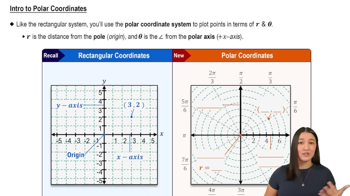
Intro to Polar Coordinates

Plotting Points

Plotting a point involves moving x units along the x-axis and y units along the y-axis from the origin (0,0). For example, the point (3, 2) is found by moving 3 units right and 2 units up from the origin.
Recommended video:
4:29
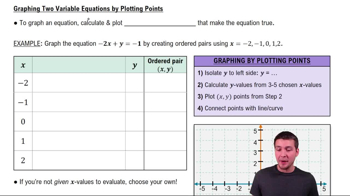
Graphing Two Variable Equations by Plotting Points

Quadrants and Axes Identification

The coordinate plane is divided into four quadrants based on the signs of x and y values: Quadrant I (+, +), Quadrant II (-, +), Quadrant III (-, -), and Quadrant IV (+, -). Points on the axes have either x=0 or y=0, indicating they lie on the x-axis or y-axis.
Recommended video:
6:36
Quadratic Formula