In Exercises 27–32, select the representations that do not change the location of the given point. (−2, 7π/6) (−2, −5π/6)
Ch. 5 - Complex Numbers, Polar Coordinates and Parametric Equations

All textbooks
Blitzer 3rd Edition
Ch. 5 - Complex Numbers, Polar Coordinates and Parametric Equations
Problem 30
Blitzer 3rd Edition
Ch. 5 - Complex Numbers, Polar Coordinates and Parametric Equations
Problem 30Chapter 5, Problem 30
In Exercises 29–36, simplify and write the result in standard form.
√−196
Verified step by step guidance1
Recognize that the expression involves the square root of a negative number, which means we are dealing with imaginary numbers in the complex number system.
Recall the definition of the imaginary unit: \(i = \sqrt{-1}\), so \(\sqrt{-a} = i\sqrt{a}\) for any positive real number \(a\).
Rewrite the expression \(\sqrt{-196}\) as \(\sqrt{-1 \times 196}\), which can be separated into \(\sqrt{-1} \times \sqrt{196}\).
Substitute \(\sqrt{-1}\) with \(i\) and simplify \(\sqrt{196}\) by finding its positive square root.
Express the final answer in standard form for complex numbers, which is \(a + bi\), where \(a\) and \(b\) are real numbers.

Verified video answer for a similar problem:
This video solution was recommended by our tutors as helpful for the problem above.
Video duration:
1mWas this helpful?
Key Concepts
Here are the essential concepts you must grasp in order to answer the question correctly.
Imaginary Numbers
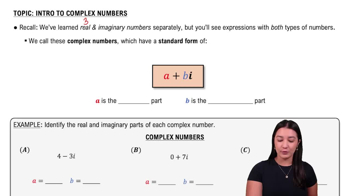
Imaginary numbers extend the real number system by including the square root of negative one, denoted as i. This allows for the definition of the square root of negative numbers, such as √−196, which can be expressed as a multiple of i.
Recommended video:
Introduction to Complex Numbers
Simplifying Square Roots
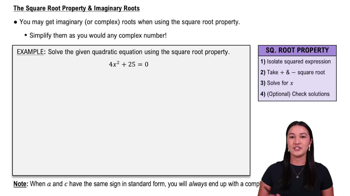
Simplifying square roots involves factoring the radicand into perfect squares and other factors. For example, √196 is simplified to 14 because 196 is 14 squared. This process helps in rewriting expressions in their simplest form.
Recommended video:
Imaginary Roots with the Square Root Property
Standard Form of Complex Numbers
The standard form of a complex number is a + bi, where a and b are real numbers and i is the imaginary unit. Writing results in this form clearly separates the real and imaginary parts, which is essential for further operations and interpretations.
Recommended video:
Complex Numbers In Polar Form
Related Practice
Textbook Question
698
views
Textbook Question
In Exercises 27–36, write each complex number in rectangular form. If necessary, round to the nearest tenth. 8(cos 7π/4 + i sin 7π/4)
522
views
Textbook Question
In Exercises 13–34, test for symmetry and then graph each polar equation. r = 1 − 3 sin θ
995
views
Textbook Question
In Exercises 29–36, simplify and write the result in standard form. ___ √−49
699
views
Textbook Question
In Exercises 29–36, simplify and write the result in standard form. ____ √−108
720
views
Textbook Question
In Exercises 21–40, eliminate the parameter t. Then use the rectangular equation to sketch the plane curve represented by the given parametric equations. Use arrows to show the orientation of the curve corresponding to increasing values of t. (If an interval for t is not specified, assume that −∞ < t < ∞. x = 1 + 3 cos t, y = 2 + 3 sin t; 0 ≤ t < 2π
868
views