Ch. R - Algebra Review
Lial - Trigonometry 12th Edition
Lial12th EditionTrigonometryISBN: 9780136552161Not the one you use?Change textbook
Chapter 1, Problem 7

CONCEPT PREVIEW Perform the operations mentally, and write the answers without doing intermediate steps. √25 + √64

Verified step by step guidance
1
Recognize that the problem involves square roots of perfect squares: \(\sqrt{25}\) and \(\sqrt{64}\).
Recall that \(\sqrt{25}\) is the number which, when squared, gives 25. Similarly, \(\sqrt{64}\) is the number which, when squared, gives 64.
Identify the values of these square roots: \(\sqrt{25} = 5\) and \(\sqrt{64} = 8\).
Add the two results together: \$5 + 8$.
Write the final answer as the sum of these two numbers without intermediate calculations.

Verified video answer for a similar problem:

This video solution was recommended by our tutors as helpful for the problem above.
Video duration:
3m
Was this helpful?

Key Concepts

Here are the essential concepts you must grasp in order to answer the question correctly.

Square Roots

The square root of a number is a value that, when multiplied by itself, gives the original number. For example, √25 equals 5 because 5 × 5 = 25. Understanding square roots helps simplify expressions involving radicals.
Recommended video:
2:20
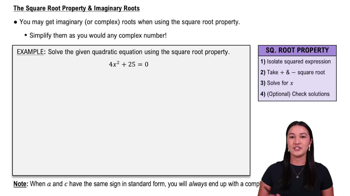
Imaginary Roots with the Square Root Property

Simplification of Radicals

Simplifying radicals involves finding the simplest form of a square root or other root expression. Recognizing perfect squares like 25 and 64 allows quick simplification to integers, making mental calculations easier.
Recommended video:
6:20
Example 6

Mental Arithmetic with Radicals

Performing operations mentally requires familiarity with common square roots and basic arithmetic. Adding simplified square roots directly, such as 5 + 8, helps solve problems quickly without writing intermediate steps.
Recommended video:
2:58
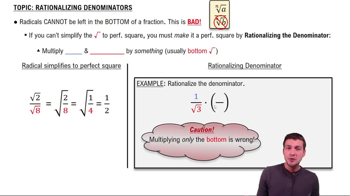
Rationalizing Denominators