Ch. 1 - Trigonometric Functions
Lial - Trigonometry 12th Edition
Lial12th EditionTrigonometryISBN: 9780136552161Not the one you use?Change textbook
Chapter 2, Problem 24

Sketch an angle θ in standard position such that θ has the least positive measure, and the given point is on the terminal side of θ. Then find the values of the six trigonometric functions for each angle. Rationalize denominators when applicable. See Examples 1, 2, and 4. (0, ―3)

Verified step by step guidance
1
Step 1: Understand the problem. We need to sketch an angle \( \theta \) in standard position whose terminal side passes through the point \( (0, -3) \). The angle \( \theta \) should be the least positive measure, meaning it lies between 0 and 360 degrees (or 0 and \( 2\pi \) radians).
Step 2: Identify the quadrant or axis where the point lies. Since the point is \( (0, -3) \), it lies on the negative y-axis. This means the terminal side of \( \theta \) is along the negative y-axis.
Step 3: Determine the angle \( \theta \) in standard position. The positive x-axis corresponds to 0 degrees (or 0 radians). Moving counterclockwise, the negative y-axis corresponds to an angle of 270 degrees (or \( \frac{3\pi}{2} \) radians). So, \( \theta = 270^\circ \) or \( \theta = \frac{3\pi}{2} \).
Step 4: Find the six trigonometric functions for \( \theta \). First, find the radius (distance from origin to the point) using the distance formula: \[ r = \sqrt{x^2 + y^2} = \sqrt{0^2 + (-3)^2} = 3. \] Then use the definitions:
\[ \sin \theta = \frac{y}{r}, \quad \cos \theta = \frac{x}{r}, \quad \tan \theta = \frac{y}{x}, \quad \csc \theta = \frac{r}{y}, \quad \sec \theta = \frac{r}{x}, \quad \cot \theta = \frac{x}{y}. \]
Step 5: Substitute the values \( x=0 \), \( y=-3 \), and \( r=3 \) into the formulas. Be careful with undefined values (like division by zero) and rationalize denominators if needed.

Verified video answer for a similar problem:

This video solution was recommended by our tutors as helpful for the problem above.
Video duration:
5m
Was this helpful?

Key Concepts

Here are the essential concepts you must grasp in order to answer the question correctly.

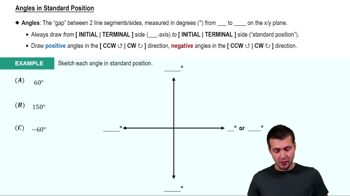
Standard Position of an Angle

An angle is in standard position when its vertex is at the origin and its initial side lies along the positive x-axis. The terminal side is determined by rotating the initial side counterclockwise by the angle measure. Sketching the angle involves placing the given point on the terminal side, which helps identify the angle's measure.
Recommended video:
05:50
Drawing Angles in Standard Position

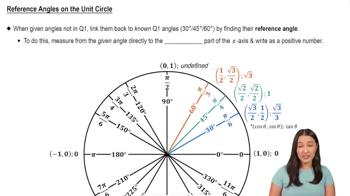
Reference Angles and Least Positive Measure

The least positive measure of an angle is the smallest positive angle that places the terminal side through the given point. For points on the coordinate plane, this often involves finding the angle between the terminal side and the x-axis, considering the quadrant where the point lies, to determine the correct angle measure.
Recommended video:
5:31
Reference Angles on the Unit Circle

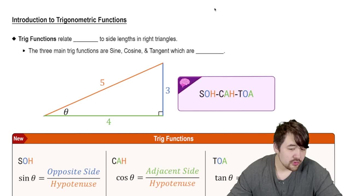
Six Trigonometric Functions from Coordinates

Given a point (x, y) on the terminal side of an angle, the six trigonometric functions—sine, cosine, tangent, cosecant, secant, and cotangent—can be found using the definitions: sin = y/r, cos = x/r, tan = y/x, where r = √(x² + y²). Rationalizing denominators ensures the answers are in simplified form.
Recommended video:
6:04
Introduction to Trigonometric Functions