
Textbook Question
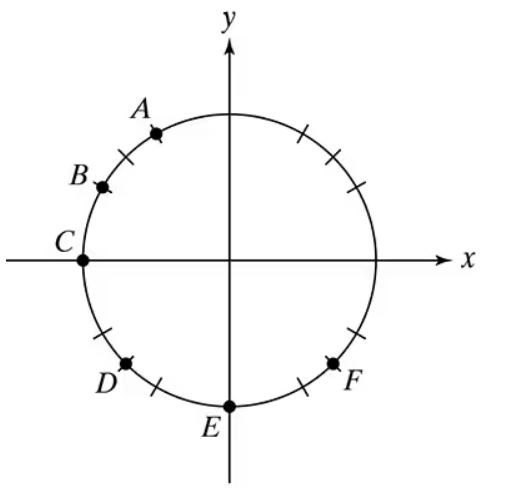
Use the circle shown in the rectangular coordinate system to solve Exercises 81–86. Find two angles, in radians, between -2𝜋 and 2𝜋 such that each angle's terminal side passes through the origin and the given point.
F
591
views

 Verified step by step guidance
 06:11
06:11
 05:50
05:50 04:46
04:46Use the circle shown in the rectangular coordinate system to solve Exercises 81–86. Find two angles, in radians, between -2𝜋 and 2𝜋 such that each angle's terminal side passes through the origin and the given point.
F
Find the absolute value of the radian measure of the angle that the second hand of a clock moves through in the given time. 3 minutes and 40 seconds
Find the absolute value of the radian measure of the angle that the second hand of a clock moves through in the given time. 55 seconds
In Exercises 87–92, find the exact value of each expression. Write the answer as a single fraction. Do not use a calculator. sin 𝜋/3 cos 𝜋 - cos 𝜋/3 sin 3𝜋/2
Use reference angles to find the exact value of each expression. Do not use a calculator. sin (-17𝜋/3)
In Exercises 61–86, use reference angles to find the exact value of each expression. Do not use a calculator. tan (-17𝜋/6)