Table of contents
- 0. Review of College Algebra4h 45m
- 1. Measuring Angles40m
- 2. Trigonometric Functions on Right Triangles2h 5m
- 3. Unit Circle1h 19m
- 4. Graphing Trigonometric Functions1h 19m
- 5. Inverse Trigonometric Functions and Basic Trigonometric Equations1h 41m
- 6. Trigonometric Identities and More Equations2h 34m
- 7. Non-Right Triangles1h 38m
- 8. Vectors2h 25m
- 9. Polar Equations2h 5m
- 10. Parametric Equations1h 6m
- 11. Graphing Complex Numbers1h 7m
1. Measuring Angles
Angles in Standard Position
Problem 45
Textbook Question
Perform each calculation. See Example 3. 90° ― 51° 28'
Verified step by step guidance1
Understand that the problem requires subtracting two angles given in degrees and minutes: \(90^\circ\) and \(51^\circ 28'\).
Recall that 1 degree (\(1^\circ\)) equals 60 minutes (\$60'$), so when subtracting, if the minutes in the minuend (top angle) are less than the minutes in the subtrahend (bottom angle), you need to borrow 1 degree (which is 60 minutes) from the degrees part.
Since \(90^\circ\) has 0 minutes and \(51^\circ 28'\) has 28 minutes, borrow 1 degree from 90 degrees, converting it to 89 degrees and adding 60 minutes to the 0 minutes, making it \(89^\circ 60'\).
Now subtract the degrees and minutes separately: subtract 28 minutes from 60 minutes, and subtract 51 degrees from 89 degrees.
Write the final answer in degrees and minutes format, combining the results from the subtraction of degrees and minutes.
Verified video answer for a similar problem:This video solution was recommended by our tutors as helpful for the problem above
Video duration:
1mPlay a video:
0 Comments
Key Concepts
Here are the essential concepts you must grasp in order to answer the question correctly.
Angle Measurement in Degrees, Minutes, and Seconds
Angles can be expressed in degrees (°), minutes ('), and seconds ("), where 1 degree equals 60 minutes and 1 minute equals 60 seconds. Understanding this notation is essential for performing calculations involving angles given in this format.
Recommended video:
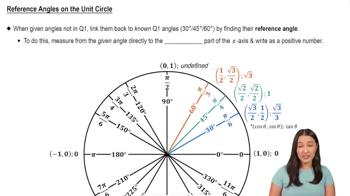
Reference Angles on the Unit Circle
Subtraction of Angles in DMS Format
When subtracting angles expressed in degrees, minutes, and seconds (DMS), you must subtract each component separately, borrowing from higher units if necessary. For example, if the seconds in the minuend are less than in the subtrahend, borrow 1 minute (60 seconds) to perform the subtraction.
Recommended video:
Adding and Subtracting Complex Numbers
Conversion Between DMS and Decimal Degrees
Converting angles from degrees, minutes, and seconds to decimal degrees (and vice versa) can simplify calculations. This involves converting minutes and seconds into fractional degrees, which is useful for verifying results or performing more complex trigonometric operations.
Recommended video:
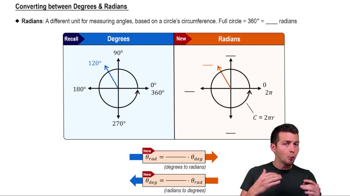
Converting between Degrees & Radians
Related Videos
Related Practice
Textbook Question
Find the measure of the smaller angle formed by the hands of a clock at the following times. 8:20
574
views