Recognize that the angle 285° is in the fourth quadrant, where tangent values are negative.
Express 285° as a sum or difference of angles whose tangent values are known. For example, write 285° as 225° + 60°.
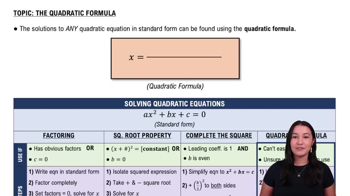
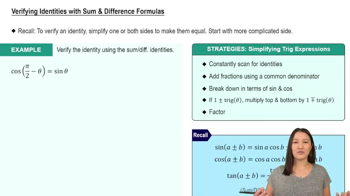
Use the tangent addition formula: \(\tan(A + B) = \frac{\tan A + \tan B}{1 - \tan A \tan B}\), where \(A = 225^\circ\) and \(B = 60^\circ\).
Recall the exact values: \(\tan 225^\circ = 1\) and \(\tan 60^\circ = \sqrt{3}\), then substitute these into the formula.
Simplify the resulting expression step-by-step to find the exact value of \(\tan 285^\circ\).
Verified video answer for a similar problem:
This video solution was recommended by our tutors as helpful for the problem above
Play a video:
0 Comments
Key Concepts
Here are the essential concepts you must grasp in order to answer the question correctly.
Reference Angles and Angle Reduction
To find the exact value of trigonometric functions for angles greater than 360° or in different quadrants, we use reference angles by subtracting or adding full rotations (360°) or known angles. For 285°, recognizing its position in the fourth quadrant helps simplify the calculation.
The tangent function is defined as the ratio of sine to cosine (tan θ = sin θ / cos θ). Its sign depends on the quadrant: tangent is positive in the first and third quadrants and negative in the second and fourth. Since 285° lies in the fourth quadrant, tan 285° is negative.
When the angle is not standard, express it as a sum or difference of known angles (e.g., 285° = 270° + 15°) and apply the tangent addition or subtraction formulas: tan(a ± b) = (tan a ± tan b) / (1 ∓ tan a tan b). This allows exact evaluation using known values.

 Verified step by step guidance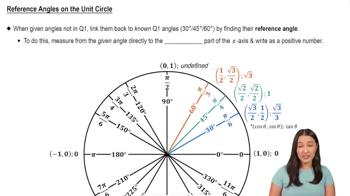
 5:31
5:31