
Ch. 4 - Graphs of the Circular Functions
Lial - Trigonometry 12th Edition
Lial12th EditionTrigonometryISBN: 9780136552161Not the one you use?Change textbook
Chapter 5, Problem 21

Identify the circular function that satisfies each description.
period is π; function is decreasing on the interval (0, π)

Verified step by step guidance
1
Recall the basic circular functions: sine (\(\sin x\)), cosine (\(\cos x\)), tangent (\(\tan x\)), cotangent (\(\cot x\)), secant (\(\sec x\)), and cosecant (\(\csc x\)), and their standard periods. For example, \(\sin x\) and \(\cos x\) have period \(2\pi\), while \(\tan x\) and \(\cot x\) have period \(\pi\).
Since the function has period \(\pi\), focus on functions with period \(\pi\). These are typically \(\tan x\) and \(\cot x\).
Next, analyze the behavior of these functions on the interval \((0, \pi)\). Determine which of these functions is decreasing on \((0, \pi)\) by considering their derivatives or known graphs.
Recall that \(\tan x\) is increasing on \((0, \pi)\) (except at discontinuities), while \(\cot x\) is decreasing on \((0, \pi)\).
Conclude that the circular function with period \(\pi\) and decreasing on \((0, \pi)\) is \(\cot x\).

Verified video answer for a similar problem:

This video solution was recommended by our tutors as helpful for the problem above.
Was this helpful?

Key Concepts

Here are the essential concepts you must grasp in order to answer the question correctly.

Period of a Trigonometric Function

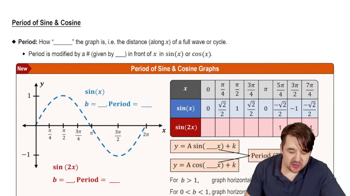
The period of a trigonometric function is the length of the smallest interval over which the function completes one full cycle and repeats its values. For example, the standard sine and cosine functions have a period of 2π, but transformations can alter this period to values like π.
Recommended video:
5:33
Period of Sine and Cosine Functions

Monotonicity of Functions on an Interval

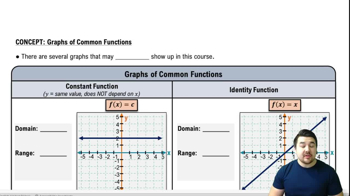
A function is decreasing on an interval if its values consistently go down as the input increases within that interval. Understanding where a trigonometric function is increasing or decreasing helps identify the function based on its behavior over specific intervals.
Recommended video:
5:57
Graphs of Common Functions

Common Circular Functions and Their Properties

Circular functions such as sine, cosine, tangent, cotangent, secant, and cosecant have distinct periods and monotonic intervals. For instance, tangent and cotangent have period π, but tangent is increasing on (−π/2, π/2), while cotangent is decreasing on (0, π), which helps in identifying the function described.
Recommended video:
5:57
Graphs of Common Functions