Evaluate each expression. See Example 4. cot² 135° - sin 30° + 4 tan 45°
Verified step by step guidance
1
Recall the definitions and values of the trigonometric functions involved: cotangent, sine, and tangent. Remember that cotangent is the reciprocal of tangent, i.e., \(\cot \theta = \frac{1}{\tan \theta}\).
Evaluate \(\cot^2 135^\circ\). First, find \(\tan 135^\circ\), then take its reciprocal to get \(\cot 135^\circ\), and finally square the result to get \(\cot^2 135^\circ\).
Evaluate \(\sin 30^\circ\) using the known exact value from the unit circle or special angles.
Evaluate \(\tan 45^\circ\) using its known exact value, then multiply this value by 4 as indicated in the expression.
Combine all the evaluated parts according to the expression: \(\cot^2 135^\circ - \sin 30^\circ + 4 \tan 45^\circ\). Perform the subtraction and addition to simplify the expression.
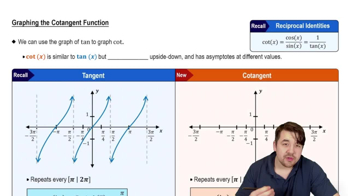
Verified video answer for a similar problem:
This video solution was recommended by our tutors as helpful for the problem above
Video duration:
4m
Play a video:
0 Comments
Key Concepts
Here are the essential concepts you must grasp in order to answer the question correctly.
Trigonometric Function Values at Special Angles
Certain angles like 30°, 45°, and 135° have well-known sine, cosine, and tangent values. Knowing these exact values helps quickly evaluate expressions without a calculator. For example, sin 30° = 1/2, tan 45° = 1, and cot 135° can be derived from the tangent of 135°.
Cotangent is the reciprocal of tangent, defined as cot θ = 1/tan θ. Understanding this relationship allows conversion between cotangent and tangent values, which is useful when evaluating expressions involving cot² terms.
When evaluating expressions with multiple trigonometric terms, apply the order of operations carefully: evaluate powers first (like cot²), then perform multiplication, and finally addition or subtraction. This ensures accurate simplification of the expression.

 4:34 minutes
 Verified step by step guidance
 6:04
6:04