Ch. 3 - Trigonometric Identities and Equations
Blitzer - Trigonometry 3rd Edition
Blitzer3rd EditionTrigonometryISBN: 9780137316601Not the one you use?Change textbook
Chapter 3, Problem 77

In Exercises 63–84, use an identity to solve each equation on the interval [0, 2𝝅). sin x + cos x = 1

Verified step by step guidance
1
Start with the given equation: \(\sin x + \cos x = 1\).
Square both sides of the equation to use the Pythagorean identity: \((\sin x + \cos x)^2 = 1^2\).
Expand the left side using the formula \((a + b)^2 = a^2 + 2ab + b^2\): \(\sin^2 x + 2 \sin x \cos x + \cos^2 x = 1\).
Use the Pythagorean identity \(\sin^2 x + \cos^2 x = 1\) to simplify the equation: \(1 + 2 \sin x \cos x = 1\).
Subtract 1 from both sides to isolate the product term: \(2 \sin x \cos x = 0\), then solve for \(x\) by setting \(\sin x \cos x = 0\) and finding all solutions in \([0, 2\pi)\).

Verified video answer for a similar problem:

This video solution was recommended by our tutors as helpful for the problem above.
Video duration:
8m
Was this helpful?

Key Concepts

Here are the essential concepts you must grasp in order to answer the question correctly.

Trigonometric Identities

Trigonometric identities are equations involving trigonometric functions that hold true for all values within their domains. In this problem, identities like the Pythagorean identity or the sum-to-product formulas help transform and simplify the equation sin x + cos x = 1 to a more solvable form.
Recommended video:
5:32
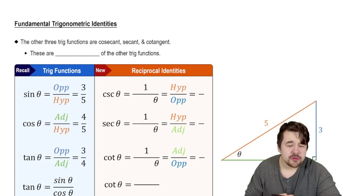
Fundamental Trigonometric Identities

Solving Trigonometric Equations

Solving trigonometric equations involves manipulating the equation using identities and algebraic techniques to isolate the variable. The goal is to find all angle values x within the given interval [0, 2Ο€) that satisfy the equation, considering the periodic nature of sine and cosine functions.
Recommended video:
4:34
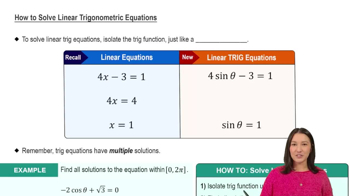
How to Solve Linear Trigonometric Equations

Interval and Periodicity of Trigonometric Functions

The interval [0, 2Ο€) represents one full cycle of sine and cosine functions. Understanding the periodicity ensures that all solutions within this range are found, and no extraneous solutions outside the interval are considered. This is crucial for correctly interpreting the solution set.
Recommended video:
5:33
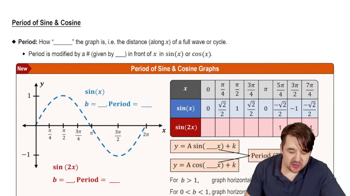
Period of Sine and Cosine Functions